Posted on — Leave a comment

Aaron publications at Music and Drama Education Expo 2017 !

Rhinegold Music and Drama Education Expo

Aaron Publications at Music & Drama Education EXPO 2017

Rhinegold EXPO 2017

In February 2017, Aaron Publications exhibited at the Music & Drama Education EXPO at London Olympia. The event, organised by Rhinegold Publishing, is one of Europe’s largest conferences and exhibitions for music and drama education.

Held on 9th–10th February 2017, the EXPO brought together educators, publishers, examination boards, and industry professionals from across the UK and beyond.


Showcasing the All-In-One Music Theory Series

At the event, Aaron Publications showcased its All-In-One music theory series, designed to support structured learning for students preparing for graded music examinations.

The series includes:

These resources were developed to support both ABRSM and Trinity College London syllabuses, offering a structured and progressive approach to learning music theory.


About the 2016–2017 Updates

The 2017 exhibition followed a major update to the All-In-One series, published in July 2016.

As stated in the book’s preface:

“The most recent edition (Third Edition) features further simplification throughout the book, making it more accessible to the young beginner and more suitable for students taking the individual grades en route to Grade 5, without losing its integrated approach.”

Find out more about the substantial differences between the Third and earlier editions of All-In-One Music Theory.

As well as the major overhaul to the contents, All-In-One third edition features:

  • Expanded exercise sections throughout the books
  • A fully revised Trinity Supplement with additional graded exercises
  • Updated Answer Book aligned with the new editions

These improvements strengthened the series as a comprehensive resource for both classroom teaching and independent study.


Event Highlights

The EXPO provided an opportunity to:

  • Introduce new editions of the All-In-One series
  • Present updated teaching materials to educators
  • Engage directly with teachers, students, and exam board representatives
  • Offer exclusive event pricing on selected titles

Visitors were also able to meet the author, Rachel Billings, and discuss the development and structure of the series.


Looking Back

The Music & Drama Education EXPO 2017 was an important milestone in raising awareness of the All-In-One series and strengthening its presence within the UK music education community.

Posted on — Leave a comment

The Importance of Music Theory

the importance of music theory

The Importance of Music Theory

Music theory helps many musicians perform better and provides a window into the composer’s mind and intentions.

The importance of music theory should be widely recognised. It is with good reason that the ABRSM exam board says students must pass the Grade 5 Music Theory exam before they can take the Grade 6, 7 or 8 practical exam on their chosen instrument. Yet most students do not study music theory in their instrumental lessons. The result is a mad rush to prepare for Grade 5 Music Theory just a few months, or even weeks, before the exam, and many students are not prepared.

Why is theory not taught earlier as part of the instrumental lesson?

There are at least three reasons.

Lack of Time

The first reason is easy to understand: lack of time. There is already much to fit into an instrumental lesson: exercises, instrumental studies, pieces, aural training… The list goes on. Theory is too often tagged on at the end or forgotten altogether (until the exam date looms!).

The Fear That Theory Will Be Boring

Secondly, there is a real fear among teachers that they will bore their student if they open a theory book. After all, isn’t music theory boring?

Many people assume that it is, and sadly this attitude is found in many teachers. This is perhaps because many teachers teach as they have been taught themselves. The problem is that theory is taught by rote, and people are used to the old “jigsaw method”, whereby dry snippets of information are given bit by bit, in the hope that they will eventually piece together and make sense to the student. For many, that day never comes!

Concerns About Parents’ Expectations

Also, thirdly, a few teachers worry that the parent may misunderstand if they devote more time to music theory. After all, isn’t the child being sent to an “instrumental” lesson? Will the mum or dad object if occasionally the instrument is put to one side and they spend half their time looking at a theory book?

Music Theory and Composing

Obviously, it is hard, if not impossible, for a musician to write a piece of music if they have little theoretical knowledge. Which time signature is best to use? How do you group the notes and rests and beam the tails accurately? How do you indicate your intentions?

Basic knowledge is essential if the music is to be written clearly and legibly. Grade 5 theory also involves some knowledge about orchestral instruments in general. It would be ludicrous to write a piece for clarinet which cannot be performed because the notes are either too high or too low for the instrument. It would also be silly to write “accelerando” (which means to get gradually faster) when you actually wish to tell the performer to slow down (“rallentando”).

The importance of music theory for composers should be obvious.

Music Theory and Performing

Some musicians may object to any mention of the dreaded two words “music theory” and respond:

“But I’m not a composer, why bother? Anyway, I learn theory whilst learning a piece of music.”

That is true, to a certain extent, but the result is often mere surface knowledge. Yes, you may be told that 12/8 time signature means counting four dotted crotchet beats in a bar, or that the current piece you are learning is in B major, which has five sharps.

But does that make sense?

It has proven hard to remember rules presented in such an abstract fashion. But not only that; can you be satisfied with such meagre understanding? Don’t you wish to know why these particular numbers are chosen and the reason such rules and conventions exist?

Understanding How Music Works

Too often the response is: “Music theory isn’t important, let’s just get on with playing the instrument!”

But knowledge of music theory should be an essential ingredient in any music lesson since it can help a person to play better on their instrument.

This statement should not be misunderstood! Of course, some students, with a good ear, know instinctively how to phrase and shape a melody without much knowledge of music theory. However, for other students, to whom this does not come naturally, a little knowledge of the building blocks used to write a piece of music, whilst not guaranteeing a musical performance, can only be beneficial.

Music theory, after all, is largely about how music works.

All musicians (even non-pianists!) should know a little about chord progressions and the direction and feeling produced by certain chords written in a particular order (so-called “harmonic progressions”). Certain chords naturally create a feeling of tension and relaxation, which in turn dictates the way the melody is shaped.

At the basic level, this knowledge is about cadences. For example, an “Interrupted Cadence” (V–vi) creates a feeling of instability, whilst a “Perfect Cadence” (V–I) feels final and complete.

Understanding the Composer’s Intentions

Some chords are unusual for the period in which they are written; for example, a “diminished chord” in Classical music. It is good to be aware that the composer intended this chord for dramatic effect.

Anyone would find it helpful to memorise a piece of music if they know about its structure. We

Posted on — 1 Comment

ABRSM vs Trinity College London Music Theory: What’s the Difference?

ABRSM vs Trinity Music Theory. What's the difference?

ABRSM vs Trinity College London Music Theory: Key Differences

If you’re deciding between ABRSM and Trinity College London Music Theory examinations, it’s useful to understand the differences between the two syllabuses. Although they have much in common, Trinity College London Music Theory includes some additional topics and different requirements.

The All-In-One Music Theory workbooks and Revision booklets have been designed to support students studying for either examination board. Each book contains graded checklists showing which topics are required for ABRSM and Trinity College London.

These checklists make it easy to follow the correct syllabus and track your progress.

Is ABRSM harder than Trinity College London Music Theory?

A common question students ask is whether ABRSM or Trinity is harder. The answer is that neither examination board is simply harder than the other. Both cover the essential foundations of music theory, but they differ in their syllabus content and approach.

ABRSM follows a more traditional theory structure, whilst Trinity includes some additional topics such as jazz chord symbols, and composition-related elements. The best choice depends on the student’s strengths, learning style and exam goals.

ABRSM vs Trinity College London Music Theory Syllabus

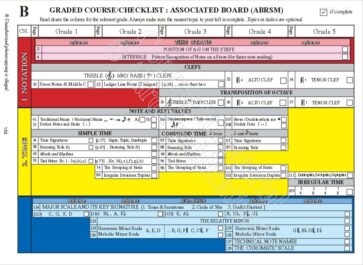
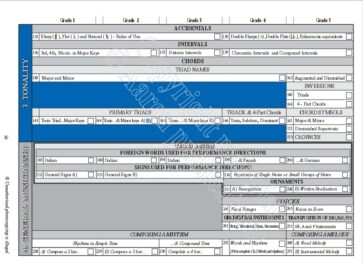
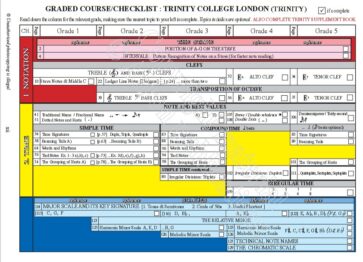
The graded checklists in All-In-One to Grade 5 show the topics required at each grade and make it easy to compare the ABRSM and Trinity College London Music Theory syllabuses.

For closer views of the graded checklists, see the product images on the All-In-One to Grade 5 Music Theory product page.


ABRSM Music Theory graded checklist showing syllabus requirements for each grade.

ABRSM Music Theory graded checklist showing syllabus requirements for each grade (page 1)

ABRSM Music Theory graded checklist showing syllabus requirements for each grade (page 2)


Trinity College London Music Theory graded checklist showing syllabus requirements for each grade.

Trinity College London graded checklist showing syllabus requirements for each grade (page 1)

Trinity College London graded checklist showing syllabus requirements for each grade (page 1)
Trinity College London Graded checklist — page 2


The checklists show at a glance which topics are required at each grade. They make it easy for students to see where the ABRSM and Trinity Music Theory syllabuses overlap and where they differ.

What Are the Differences Between ABRSM and Trinity Music Theory?

Although there are many similarities between the two examination boards, there are also several important differences. These can be seen by comparing the graded syllabus checklists included in the All-In-One Music Theory books.

ABRSM Music Theory follows a more traditional approach and introduces a wider range of key signatures at an earlier stage.

Trinity College London Music Theory places greater emphasis on composition and includes some topics that are particularly useful for students with an interest in jazz and popular music. In addition to Roman numeral analysis, Trinity also introduces jazz chord symbols.

There are also differences in when particular topics are introduced:

  • Compound time signatures are introduced at Grade 3 by both examination boards.
  • ABRSM students are expected to learn a broader range of key signatures at an earlier stage than Trinity students.
  • Trinity students are introduced to major, minor and perfect intervals at Grade 2, one grade earlier than ABRSM students, who encounter them at Grade 3.

These differences mean that, although the two syllabuses cover many of the same fundamental areas of music theory, they do not always introduce topics in the same order or place the same emphasis on them.

For a more detailed comparison, see the graded syllabus checklists provided at the front of the All-In-One Music Theory books.

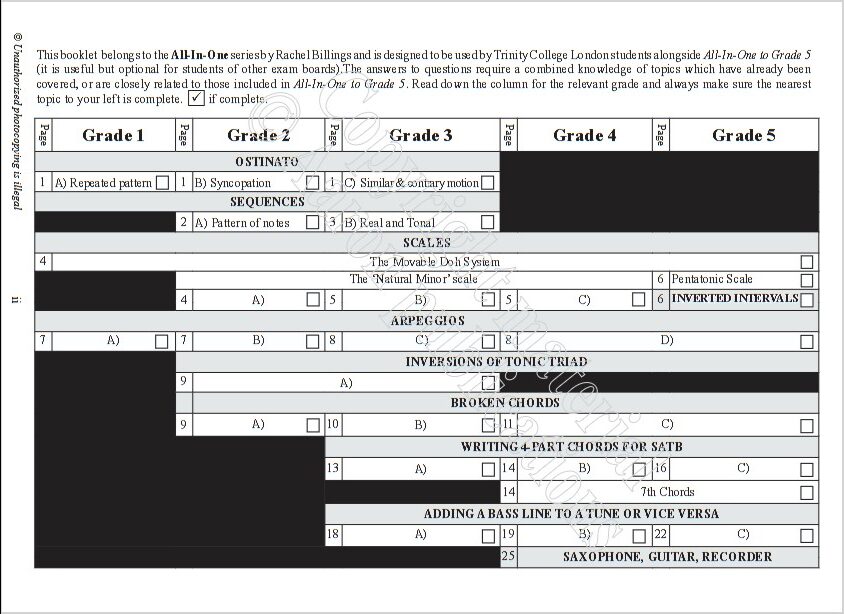
The Trinity College London Supplement Booklet – All-In-One to Grade 5 contains extension exercises that build upon topics covered in the main workbook, as well as additional topics and exercises designed to support students following the Trinity syllabus.

Contents page Trinity College London Music Theory Supplement for All-In-One to Grade 5
Trinity College `London Supplement

Topics Covered in the Trinity Supplement but Not Explicitly Required by the ABRSM Syllabus

The following topics are covered in the Trinity College London Supplement but are not explicitly included as requirements in the ABRSM Grades 1–5 syllabus:

  • Ostinato
  • Syncopation
  • Real and tonal sequences
  • The natural minor scale
  • The pentatonic scale
  • Inverted intervals
  • Arpeggios
  • Inversion of tonic triads
  • Broken chords
  • Writing four-part chords for SATB
  • Dominant 7th chords
  • Basic knowledge of the guitar and saxophone

Detailed information about syllabus requirements can be found on other pages of this website, next to relavent articles. For example:

Part 1: Aural Exercises: Real and Tonal Sequences (Grades 4 – 5 Aural Exercises)
F.A.Q section at the bottom of the page answers the question: Do both ABRSM and Trinity students need to know about sequences?


Trinity College London Music Theory Grades 1–5

Trinity College London offers Music Theory examinations from Grades 1–5. Although Trinity and ABRSM cover many of the same areas, Trinity includes additional topics that students following the All-In-One to Grade 5 (Third Edition) need to study separately.

The Trinity College London Music Theory Supplement covers these additional topics in a 26-page workbook and is designed to be used alongside All-In-One to Grade 5.


Which Music Theory book do I need for Trinity or ABRSM?

The All-In-One Music Theory series has been written to support students preparing for both ABRSM and Trinity College London examinations.

  • ABRSM students require only one book: All-In-One to Grade 5, All-In-One: Grades 1–3 or All-In-One: Grades 4–5.
  • Trinity College London students using All-In-One to Grade 5 (Third Edition) should also use the Trinity College London Music Theory Supplement alongside the main book.
  • Trinity students using All-In-One: Grades 1–3 or All-In-One: Grades 4–5 do not need the separate Trinity Supplement because the relevant additional Trinity material is already included in the appendices.

The Trinity Supplement introduces topics that build naturally on material already covered in the main book. For example, students who understand tonic chords and inversions will find broken chords a straightforward next step. Similarly, students who understand diatonic intervals can build on this knowledge when learning about inverted intervals.

Many students, not only those taking Trinity examinations, find this additional music theory material valuable.


Which is better: ABRSM or Trinity Music Theory?

Neither examination board is simply better than the other. Both provide a structured approach to music theory, but they differ in the topics they introduce and the way some areas are assessed.
If you are choosing between ABRSM and Trinity College London Music Theory, look at the syllabus for your particular grade and consider which approach best suits your needs.


Relevant articles:

Is Grade 6 Music theory much harder than Grade 5?

View our article: Can I Use My Trinity Grade 5 Theory Pass for ABRSM Grade 6?

Ready to choose your book?

Whether you’re studying for ABRSM or Trinity College London, the All-In-One Music Theory series provides a structured way to prepare for your exams. Explore the All-In-One Music Theory workbooks and Revision booklets including the All-In-One to Grade 5, Grades 1–3 and Grades 4–5 editions.

Studying Trinity using All-In-One to Grade 5 (Third Edition)?
You will also need the Trinity College London Music Theory Supplement.