How the All-In-One Music Theory Books Work: ABRSM, Trinity & VCM Syllabus Requirements
About the All-In-One Approach
You do not need this page in order to use an All-In-One Music Theory book. Each book is designed to be used on its own and includes:
- footnote guides directing you to relevant topics;
- a “How to Use this Material” section at the beginning of the book; and
- Graded Checklists for ABRSM, Trinity and (Revised Editions) VCM exams, to check that all topics for the relevant examination board have been covered.
This page is an additional reference for students, teachers and others who want to see how the All-In-One material corresponds to the published syllabus requirements for ABRSM, Trinity College London and VCM.
The sections below list the relevant syllabus requirements for each examination board, grade by grade, and show how they relate to the topics and Graded Checklists in the All-In-One Music Theory books.
The All-In-One approach focuses on patterns, relationships and principles that continue across the grades. Rather than treating each grade as a completely separate list of facts to memorise, the books show how different areas of music theory connect and develop.
For example, Major and Minor Chords are introduced across Grades 1–4. Students do not need to know key signatures to complete these exercises; they only need to be able to count semitones. This allows the principle of chord construction to be introduced and developed without making it unnecessarily dependent on other knowledge.
Similarly, once students understand the principles behind fractions, note values and rhythmic grouping, they can apply those principles across different time signatures.
The aim is to build a connected understanding of music theory, rather than breaking the subject into isolated pieces simply because particular topics appear in different examination grades.
How to Read the Graded Checklist
The Graded Checklist makes it easy to see which material is relevant to each grade. There is a tick box next to each subject, so students can mark each topic when they have completed it.
All topics have been grouped into four colour-coded sections:
- Notation
- Time
- Tonality
- General Musicianship
Read down the column for the grade you are studying, and always make sure that the nearest relevant topic to the left has been completed where applicable.
ABRSM Grades 1 – 5 Music Theory – Syllabus Requirements & Topics
ABRSM Music Theory graded checklist showing syllabus requirements for each grade – Page 1 of 2 from All-In-One to Grade 5
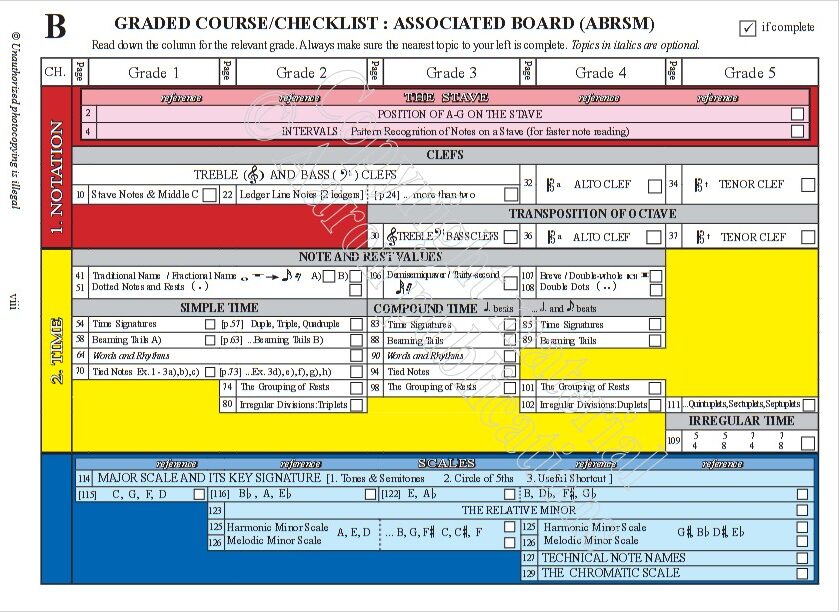 The second page is not shown here for copyright reasons. The complete contents pages are available in the book
ABRSM Grade 1 Music Theory – Syllabus Requirements & Topics
TREBLE AND BASS CLEF
Page 2 – Position of A–G on the Stave
Page 4 – Intervals: Pattern Recognition of Notes on a Stave (number only)
Page 10 – Stave Notes and Middle C
NOTE AND REST VALUES
Page 41 – Traditional Names: The Semibreve, Minim, Crotchet, Quaver and Semiquaver
Page 46 – Fractional Names: Whole note, half, quarter, eighth, sixteenth
Page 51 – Dotted notes and Rests
SIMPLE TIME
Page 54 – Time Signatures: 2/4, 3/4, 4/4
ABRSM covers the following topics using these time signatures…
Page 58 – Beaming Tails A)
Page 64 – Words and Rhythms
Page 70 – Tied Notes Ex. 1–3a (Basic rules)
MAJOR SCALE AND ITS KEY SIGNATURES
Pages 114–122 – Tone and semitones, circle of 5ths, useful shortcut
Page 115 – Major Keys: C, G, F, D (up to one sharp or flat)
ACCIDENTALS, INTERVALS AND CHORDS
ABRSM covers the following topics using Grade 1 keys…
Page 132 – Accidentals: Rules of Use
Page 136 – Intervals (numbers only)
Page 138 – Major and Minor Triads
Page 143 – Tonic Triad
GENERAL EXERCISES
Page 183 – Grade 1 Italian Words
a tempo, accelerando (or accel.), adagio, allegretto, allegro, andante, cantabile, crescendo (or cresc.), da capo (or D.C.), decrescendo (or decresc.), diminuendo (or dim.), dolce, f (forte), ff (fortissimo), fine, al fine, legato, mf (mezzo forte), moderato,
mp (mezzo piano), p (piano), pp (pianissimo), rallentando (or rall.), ritardando (or ritard. or rit.), staccato (or stacc.)
Page 212 – General Signs A)
crescendo, diminuendo, slur, tie, staccato, accent, pause, metronome indications, repeat marks, common time
ABRSM Grade 2 Music Theory – Syllabus Requirements & Topics
TREBLE AND BASS CLEF
Page 22 – Ledger Line Notes (up to 2 ledger lines)
SIMPLE TIME
Page 57 – Time Signatures: Duple, Triple, Quadruple
Page 63 – Beaming Tails B): Rules for 2/2, 3/2 and 4/8 time
Page 73 – Tied Notes: Continued (Exercises 3d–h)
Page 74 – The Grouping of Rests
Page 80 – Irregular Divisions: Triplets
MAJOR SCALE AND ITS KEY SIGNATURES
Pages 114–122 – Tone and semitones, circle of 5ths, useful shortcut (reference)
Page 116 – Major Keys: B♭, A, E♭ (up to 3 sharps or flats)
Pages 125–126 – Harmonic and/or Melodic Minor: B, G, F#, C, C#, F (up to 4 sharps or flats)
ACCIDENTALS, INTERVALS AND CHORDS
Page 132 – Accidentals: Rules of Use
Students are expected to combine their knowledge of accidentals and Grade 2 key signatures by rewriting a short passage, either with or without a key signature. See the Grade 2 Music Theory Revision Booklet for additional equivalent exercises.
ABRSM covers the following topics using Grade 2 keys and topics from previous grades:
Page 136 – Intervals (numbers only, counted above the root note)
Page 138 – Major and Minor Triads
Page 144 – Tonic Triad in Minor Keys A) B)
GENERAL EXERCISES
Page 188 – Grade 2 Italian Words
alla marcia, allargando, con moto, con, col, dal segno (or D.S.), e, ed, espressivo (or espress.), fp (fortepiano), grave, grazioso, largo, lento, ma, meno, meno mosso, molto, non troppo, più, più mosso, poco, poco a poco, presto, ritenuto (or riten. or rit.), senza, vivace, viv.
Please note that ABRSM has reduced its list of required Italian terms in recent years. While the terms above reflect the current ABRSM requirements, All-In-One Music Theory retains a longer and more comprehensive list of terms, providing students with a broader vocabulary of musical terminology.
Page 215 – General Signs B)
strong accent, semi-staccato, staccatissimo, tenuto, 8va, alla breve, multiple-bar rests, volta bracket
ABRSM Grade 3 Music Theory – Syllabus Requirements & Topics
TREBLE AND BASS CLEF
Page 24 – Ledger Line Notes (more than 2 lines; “Ledger Line Lament” story). Syllabus states up to 3 lines.
Page 30 – Transposition of Octave in the Treble and Bass Clef
NOTE AND REST VALUES
Page 106 – Demisemiquaver / Thirty-second Note
COMPOUND TIME
Dotted crotchet beats
Page 83 – Time Signatures
Page 88 – Beaming Tails
Page 94 – Tied Notes
Page 98 – The Grouping of Rests
MAJOR SCALE AND ITS KEY SIGNATURES
Pages 114–122 – Tone and semitones, circle of 5ths, useful shortcut (reference)
Pages 114–122 – Scales & Key Signatures: Major Keys E, A♭ (up to 4 sharps or flats)
Pages 125–126 – Harmonic and/or Melodic Minor: B, G, F#, C, C#, F (up to 4 sharps or flats)
ACCIDENTALS, INTERVALS AND CHORDS
Page 132 – Accidentals: Rules of Use
See the Grade 3 Music Theory Revision Booklet for exercises requiring combined knowledge of accidentals and key signatures, such as rewriting a melody with or without a key signature.
Page 153 – Diatonic Intervals (limited to intervals above the tonic in Grade 3 keys only)
Page 138 – Major and Minor Triads (beginning on any note)
Page 144 – Tonic Triad in Minor Keys B) (Grade 3 keys)
GENERAL EXERCISES
Page 194 – Grade 3 Italian Words
agitato, andantino, animato, ben, con forza, energico, giocoso, leggiero, maestoso, marcato, marc., pesante, prestissimo, prima, primo, risoluto, scherzando, semplice, sempre, sforzando, sforzato, sfz, sf, simile (or sim.), sostenuto, sost., subito, sub., tranquillo
,triste, tristamente
Please note that ABRSM has reduced its list of required Italian terms in recent years. While the terms above reflect the current ABRSM requirements, All-In-One Music Theory retains a longer and more comprehensive list of terms, providing students with a broader vocabulary of musical terminology.
Page 215 – General Signs B)
ABRSM Grade 4 Music Theory – Syllabus Requirements & Topics
ALTO CLEF
Page 32 – Alto Clef Notation
Page 36 – Transposition of Octave
NOTE AND REST VALUES
Page 107 – Breve / Double Whole Note
Page 108 – Double Dots
COMPOUND TIME
Including dotted minim and dotted quaver beats
Page 85 – Time Signatures
Page 89 – Beaming Tails
Page 101 – The Grouping of Rests
Page 102 – Irregular Divisions: Duplets
Page 104 – Conversion of Simple Time to Compound Time and Vice Versa
MAJOR SCALE AND ITS KEY SIGNATURES
Page 122 – Major Keys: B, D♭ (keys up to 5 sharps or flats)
Pages 125–126 – Harmonic and/or Melodic Minor: G#, B♭ (keys up to 5 sharps or flats)
Page 127 – Technical Note Names
Page 129 – The Chromatic Scale
ACCIDENTALS, INTERVALS AND CHORDS
Page 150 – Double Sharps and Double Flats and Enharmonic Equivalents
Page 159 – Chromatic Intervals
Page 146 – Tonic, Subdominant, Dominant Chords (in keys for Grade 4)
GENERAL EXERCISES
Page 188 – Performance Directions: Grade 4 Italian Words & French Words
Italian words
affettuoso, alla breve, amabile, appassionato, assai, come prima, comodo, tempo, comodo, con brio, deciso, larghetto, mesto, misterioso, ritmico, rubato, tempo rubato, stringendo,
French terms
animé, douce, lent, modéré, retenu, vite
Please note that ABRSM has reduced its list of required Italian terms in recent years. While the terms above reflect the current ABRSM requirements, All-In-One Music Theory retains a longer and more comprehensive list of terms, providing students with a broader vocabulary of musical terminology.
Page 219 – Ornaments A): Recognition
Page 241 – Orchestral Instruments: Strings, Woodwind, Brass, Percussion
ABRSM Grade 5 Music Theory – Syllabus Requirements & Topics
TENOR CLEF
Page 34 – Tenor Clef Notation
Page 37 – Transposition of Octave in the Tenor Clef
SIMPLE & COMPOUND TIME
Page 111 – Quintuplets, Sextuplets, Septuplets
IRREGULAR TIME
Page 103 – Time Signatures: 5/4, 5/8, 7/4, 7/8
MAJOR SCALE AND ITS KEY SIGNATURES
Page 122 – Major Keys: F#, G♭ (keys up to 6 sharps or flats)
Pages 125–126 – Harmonic and/or Melodic Minor: D#, E♭ (keys up to 6 sharps or flats)
ACCIDENTALS, INTERVALS AND CHORDS
Page 159 – Compound Intervals (Diatonic and Chromatic)
INVERSIONS
Page 140 – Inversions of Triads
Page 154 – Inversion of 4-Part Chords
CHORD SYMBOLS (ROMAN NUMERAL & JAZZ CHORD NOTATION)
Page 167 – Major and Minor
Page 172 – Diminished Supertonic
Page 162 – Augmented and Diminished
CADENCES
Page 173 – Cadences
GENERAL EXERCISES
Page 188 – Performance Directions: Grade 5 Italian, French and German Words
Italian terms
a niente, ad libitum, ad lib., attacca, cantando, con dolore, con spirito, doloroso, largamente, morendo, perdendosi, quasi, rinforzando, rf, rfz, rinf., smorzando, smorz., sonoro, sotto voce
German terms
langsam, lebhaft, mässig, ruhig, schnell, traurig
Please note that ABRSM has reduced its list of required Italian terms in recent years. While the terms above reflect the current ABRSM requirements, All-In-One Music Theory retains a longer and more comprehensive list of terms, providing students with a broader vocabulary of musical terminology.
Page 219 – Ornaments A): Recognition
Page 241 – Orchestral Instruments: Strings, Woodwind, Brass, Percussion
TRANSPOSITION
Page 251 – Transposition of 2nd, 3rd, 5th
Trinity Music Theory Grades 1–5 – Syllabus Requirements & Topics
Trinity College London Music Theory Graded Checklist – Page 1 of 2
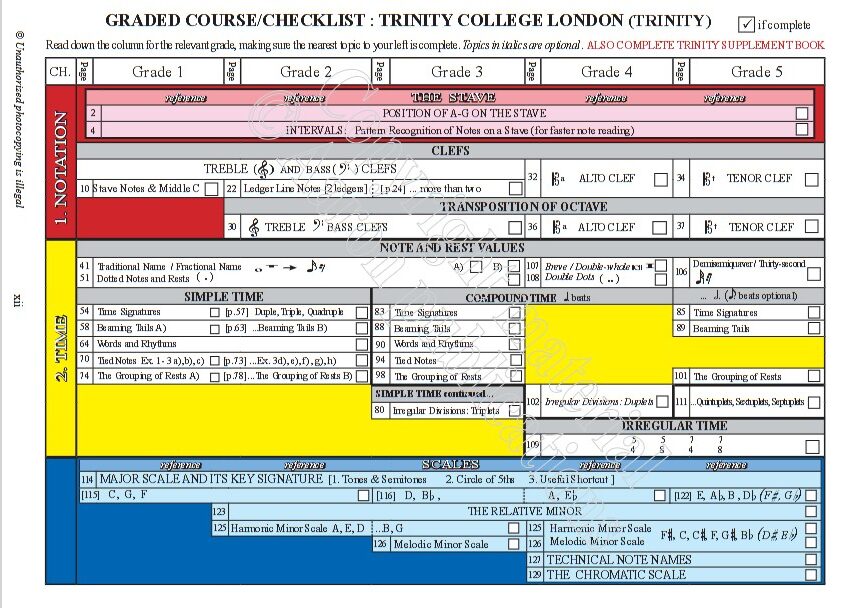 The second page is not shown here for copyright reasons. The complete contents pages are available in the book.
Trinity Students also need the Trinity College London Music Theory Supplement | Grades 1–5 to cover all syllabus requirements.
Trinity Grade 1 Music Theory – Syllabus Requirements & Topics
See Trinity College London’s own detailed syllabus information for the requirements of each grade.
TREBLE AND BASS CLEF
Page 2 – Position of A–G on the Stave
Page 4 – Intervals: Pattern Recognition of Notes on a Stave (number only)
Page 10 – Stave Notes and Middle C
NOTE AND REST VALUES
Page 41 – Traditional Names: The Semibreve, Minim, Crotchet, Quaver and Semiquaver
Page 46 – Fractional Names: Whole note, half, quarter, eighth, sixteenth
Page 42 – Dotted Minim
SIMPLE TIME
Page 54 – Time Signatures 2/4, 3/4, 4/4, Common time (C)
Page 58 – Beaming Tails A)
Page 64 – Words and Rhythms
Page 70 – Tied Notes
MAJOR SCALE AND ITS KEY SIGNATURES
Pages 114–122 – Tone and semitones, circle of 5ths, useful shortcut
Page 115 – Major Keys: C, G, F (up to one sharp or flat)
ACCIDENTALS, INTERVALS AND CHORDS
Page 132 – Accidentals: Rules of Use
Page 136 – Intervals (numbers only)
Page 138 – Major and Minor Triads (beginning on any note)
Page 143 – Tonic Triad (Grade 1 keys only)
GENERAL EXERCISES
Page 183 – Grade 1 Italian Words
Page 212 – General Signs A)
Musical words & symbols, Dynamic & articulation marks, Pianissimo, piano, mezzo piano, mezzo forte, forte, fortissimo, accents, crescendo, diminuendo, legato, slurs, staccato (and signs and abbreviations for these where appropriate).
Tempo marks & other signs, Andante, allegro, moderato, repeat marks, ritardando (and signs and abbreviations for these where appropriate)
COMPOSING
Page 228 – B) Compose a 2-bar Rhythm
From the Trinity College London Music Theory Supplement | Grades 1–5
Grade 1:
Page 1 Ostinato
Page 4 The Moveable Doh System
Page 7 Writing an Arpeggio (in Grade 1 key)
Trinity Grade 2 Music Theory – Syllabus Requirements & Topics
See Trinity College London’s own detailed syllabus information for the requirements of each grade.
TREBLE AND BASS CLEF
Page 22 – Ledger Line Notes (up to 2 ledger lines)
Page 30 – Transposition of Octaves in the Treble and Bass Clef
NOTES AND RESTS
Page 41 Semiquavers
Page 51 Dotted crotchet
SIMPLE TIME
Page 57 – Time Signatures – Duple, Triple, Quadruple – addition of 2/2, 3/2 and 4/8 time
Knowledge of the new time signatures is applied to…
Page 63 – Beaming Tails B)
Page 64 – Words and Rhythms
Page 73 – Tied Notes – Exercises 3d), e), f), g), h)
Page 78 – The Grouping of Rests B)
MAJOR SCALE AND ITS KEY SIGNATURES
Pages 114–122 – Tone and Semitones, Circle of 5ths, Useful Shortcut
Pages 115–116 – Major Keys: C, G, F (up to 1 sharp or flat)
Pages 125–126 – Harmonic Minor: A, E, D (up to 1 sharp or flat)
ACCIDENTALS AND INTERVALS
Page 132 – Accidentals – Rules of Use
Page 153 – Diatonic Intervals A) Unison, Major 2nd, Minor 2nd, Major 3rd, Minor 3rd, Perfect 4th, perfect 4th and perfect 5th
Page 138 – Major and Minor Chords
Trinity covers the following topics using Grade 2 keys and keys from previous grades…
INVERSIONS
Page 140 – Inversions of Triads
PRIMARY TRIADS
Page 144 – Tonic Triad in Minor Keys
GENERAL EXERCISES
Page 188 – Grade 2 Italian Words
Page 215 – General Signs B)
Dynamic & articulation marks, Decrescendo, phrase marks, tenuto (and signs and abbreviations for these where appropriate)
Tempo, expression marks & other words and signs, Adagio, allegretto, cantabile, espressivo, first and second time bars, grazioso,
metronome marks, molto, octave signs, pause mark (fermata), vivace (and signs and abbreviations for these where appropriate).
VOICES
Page 264 – Vocal Ranges
COMPOSING
Page 229 – B) Compose a 3-bar Rhythm
From the Trinity College London Music Theory Supplement | Grades 1–5
Grade 2:
Page 1 – Ostinato – Syncopation
Page 2 – A) Sequences – Pattern of Notes
Page 4 – The moveable Doh System
Trinity covers the following topics using Grade 2 keys and keys from previous grades:
Page 4 – The Natural Minor Scale A)
Page 7 – Arpeggios B)
Page 9 – Inversion of Tonic Chord A)
Page 9 – Broken Chords A)
Trinity Grade 3 Music Theory – Syllabus Requirements & Topics
See Trinity College London’s own detailed syllabus information for the requirements of each grade.
TREBLE AND BASS CLEF
Page 2 – Position of A–G on the Stave
Page 4 – Intervals (number only)
Page 24 – Ledger Line Notes – more than 2 ledger lines (‘Ledger Line Lament’ story)
Page 30 – Transposition of Octaves in the Treble and Bass Clef
NOTE AND REST VALUES
Page 51 – Dotted Quaver Notes and Rests
SIMPLE TIME
Page 80 – Irregular Divisions: Triplets
COMPOUND TIME
Dotted crotchet beats
Page 83 – Time Signatures
Page 88 – Beaming Tails
Page 90 – Words and Rhythms
Page 94 – Tied Notes
Page 98 – The Grouping of Rests
MAJOR SCALE AND ITS KEY SIGNATURES
Pages 114–122 – Tone and Semitones, Circle of 5ths, Useful Shortcut
Page 115 – Major Keys: D, B♭ (up to 2 sharps or flats)
Pages 25–26 – Melodic Minor: B, G (up to 2 sharps or flats)
ACCIDENTALS, INTERVALS AND CHORDS
Trinity covers the following topics using Grade 3 keys and keys from previous grades:
Page 132 – Accidentals – Rules of Use
Page 155 – Diatonic Intervals B) (intervals are counted from the tonic in Grade 3 keys only)
Page 138 – Major and Minor Triads
Page 145 – Tonic Triad in Minor Keys
CADENCES
Page 173 – Perfect Cadence
GENERAL EXERCISES
Page 194 – Grade 3 Italian Words
Page 215 – General Signs B)
Dynamic & articulation marks, Marcato, semi-staccato(and signs and abbreviations for these where appropriate)
Tempo, expression marks & other words and signs. Al, alla, a tempo, con, da Capo al Fine, dolce, down-bow, e, ed, leggiero, ma, marziale, meno, mosso, moto, non, più, poco, tranquillo, troppo, up-bow, vivo
(and signs and abbreviations for these where appropriate)
VOICES
Page 264 – Vocal Ranges
ORCHESTRAL INSTRUMENTS
Page 241 – Orchestral Instruments: String, Woodwind, Brass, Percussion
COMPOSING
Page 230 – Simple & Compound Time: Composing a 4-bar Rhythm
From the Trinity College London Music Theory Supplement | Grades 1–5
Grade 3:
Page 1 – C) Ostinato in Similar & Contrary moetiontion
Page 2 – B) Real and Tonal Sequences
Page 4 – The moveable Doh System
Trinity covers the following topics using Grade 3 keys and keys from previous grades:
Page 13 – Writing 4-Part Chords for SATB A)
Page 4 – The natural Minor scale A)
Page 7 – Arpeggios C)
Page 9 – Inversion of Tonic Chord A)
Page 9 – Broken Chords A)
Trinity Grade 4 Music Theory – Syllabus Requirements & Topics
See Trinity College London’s own detailed syllabus information for the requirements of each grade.
ALTO CLEF
Page 2 – Position of A–G on the Stave
Page 4 – Intervals (number only)
Page 32 – Alto clef notation
Page 36 – Transposition of Octaves in the Alto Clef
NOTE AND REST VALUES
Page 107 – Breve/Double whole
Page 108 – Double Dots
COMPOUND TIME
(…including dotted-minim and dotted-quaver beats)
Page 101 – The Grouping of Rests
Page 102 – Irregular Divisions: Duplets
IRREGULAR TIME
Page 109 – 5/4, 5/8, 7/4, 7/8
Page 102 – Irregular Divisions: Duplets
MAJOR SCALE AND ITS KEY SIGNATURES
Pages 114–122 – Tone and Semitones, Circle of 5ths, Useful Shortcut
Page 122 – Major Keys: A, E♭ (up to 3 sharps or flats)
Pages 125–126 – Harmonic and Melodic Minor: F#, C (up to 3 sharps or flats)
Page 127 – TECHNICAL NOTE NAMES
Page 129 – THE CHROMATIC SCALE
ACCIDENTALS, INTERVALS AND CHORDS
Trinity covers the following topics using Grade 4 keys and keys from previous grades
Page 150 – Double Sharps and Double Flats
Page 157 – Diatonic Intervals C)
Page 138 – Major and Minor Triads
Page 159 – Chromatic Intervals and Compound Intervals
4-PART CHORDS IN ROOT POSITION
Page 146 – Tonic, Subdominant, Dominant Chords
CHORD SYMBOLS (ROMAN NUMERAL & JAZZ CHORD NOTATION)
Page 167 – Major and Minor Triads
CADENCES
Page 173 – Perfect and…Plagal Cadence
Page 176 – Recognising and writing unaccented passing notes
GENERAL EXERCISES
Page 188 – Performance Directions for Grade 4:
Dynamic & articulation marks, Fortepiano, sforzando (and signs and abbreviations for these where appropriate)
Tempo, expression, marks & other words and signs, Accelerando, animato, assai, con moto, ben, brio, giocoso, largo, l’istesso, maestoso, pesante, primo, sempre, senza, simile, subito, troppo, ma non troppo
(and signs and abbreviations for these where appropriate)
Page 251 – Transposition: Transposing a tune up or down a perfect 4th or 5th (within the keys for the grade)
Page 241 – Orchestral Instruments – String, Woodwind, Brass, Percussion
Ranges (and transposing intervals where appropriate) of French horn, descant recorder, oboe, viola, double bass and guitar. Knowing which families the above instruments come from (brass, woodwind, string)
COMPOSING
Page 232 – Words and Rhythms
From the Trinity College London Music Theory Supplement | Grades 1–5
Grade 4:
Page 4 – The moveable Doh System
In the keys for grade 4 and previous…
Page 5 – The natural Minor scale C)
Page 7 – Arpeggios D)
Page 9 – Broken Chords C)
Page 14 – Writing 4-Part Chords for SATB B)
Page 14 – 7th Chords
Page 19 – Adding a bass line to a Tune or Vice-Versa B)
Page 25 – Guitar, Recorder
Trinity Grade 5 Music Theory – Syllabus Requirements & Topics
See Trinity College London’s own detailed syllabus information for the requirements of each grade.
TENOR CLEF
Page 37 – Tenor clef notation
Page 37 – Transposition of Octaves in the Tenor Clef
NOTE AND REST VALUES
Page 106 – Demisemiquaver / Thirty-second Note
SIMPLE
Page 57 – Time Signatures 4/2
COMPOUND TIME
Including dotted minim beats
Page 83 – Time Signatures
Page 88 – Beaming Tails
Page 111 – Quintuplets, Sextuplets, Septuplets
IRREGULAR TIME
Page 103 – 7/4, 7/8
Page 101 – The Grouping of Rests
Page 102 – Irregular Divisions: Duplets
MAJOR SCALE AND ITS KEY SIGNATURES
Pages 114–122 – Tone and Semitones, Circle of 5ths, Useful Shortcut
Page 122 – Major Keys: B, D♭
Pages 125–126 – Harmonic and/or Melodic Minor: G#, B♭
Page 127 – TECHNICAL NOTE NAMES
Page 129 – THE CHROMATIC SCALE
ACCIDENTALS, INTERVALS AND CHORDS
Page 150 – Double Sharps and Double Flats
Page 159 – Chromatic Intervals and Compound Intervals
4-Part Chords in Root Position
Page 145 – Tonic, Subdominant, Dominant
CHORD SYMBOLS (ROMAN NUMERAL & JAZZ CHORD NOTATION)
Page 167 – Major and Minor Triads
Page 172 – Diminished Supertonic
CADENCES
Page 173 – Perfect, Plagal… and Imperfect Cadences
GENERAL EXERCISES
Page 188 – Musical Words and Symbols
Dynamic & articulation marks, Pedal signs for piano/keyboard, sotto voce, una corda (and signs and abbreviations for these where appropriate) Tempo, expression marks & other words and signs, Agitato, arpeggiando, con forza, energico, grave, larghetto, appassionata, fuoco, morendo, niente, quasi, risoluto, rubato, scherzando, secondo, stringendo, tempo giusto.
Page 219 – Ornaments A) Recognition
Page 241 – Orchestral Instruments – String, Woodwind, Brass, Percussion
Ranges of the alto saxophone in Eb and trumpet and clarinet in Bb as
defined in the workbook
Page 250 – Strophic, Verse and Refrain (or Chorus) and binary forms
TRANSPOSITION
Page 251 – Transposition of 2nd, 3rd, 5th
From the Trinity College London Music Theory Supplement | Grades 1–5
Grade 5:
Page 6 – The Pentatonic Scale
Page 6 Inverted Intervals
In the keys for grade 5 and previous…
Page 7 – Arpeggios D)
Page 9 – Broken Chords C)
Page 14 – Writing 4-Part Chords for SATB C)
Page 14 – 7th Chords
Page 22 – Adding a bass line to a Tune or Vice-Versa C)
Page 25 – Saxophone in E flat
VCM Music Theory Grades 1–5 – Syllabus Requirements & Topics
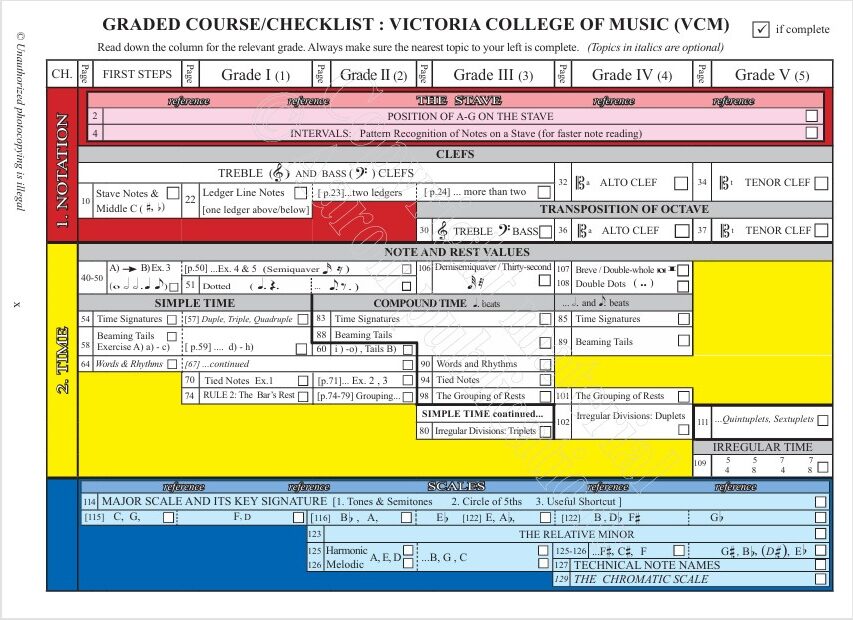
Victoria College of Music Graded Checklist – Page 1 of 2
Victoria College of Music Graded Checklist – Page 2
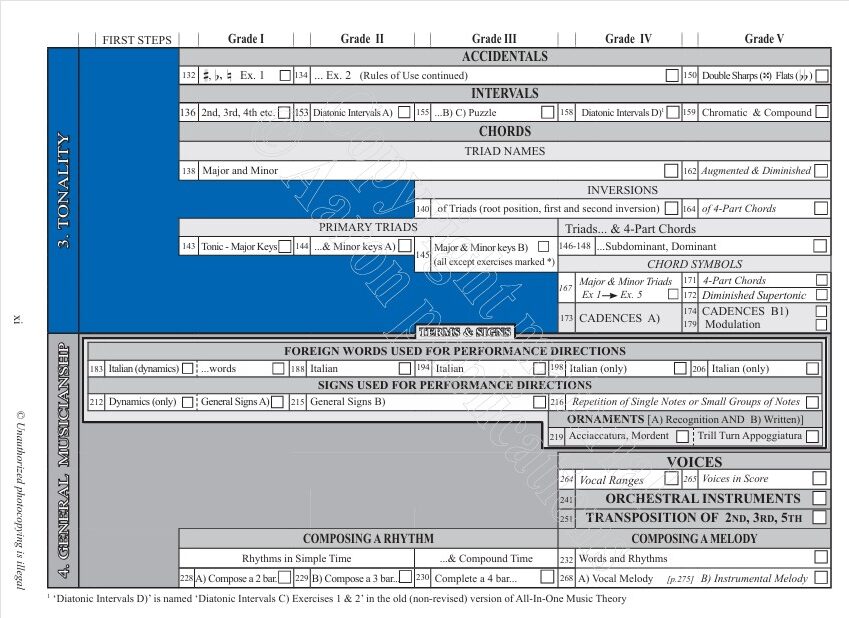
VCM ‘First Steps’ Music Theory – Syllabus Requirements & Topics
For full details of Victoria College of Music Theory syllabus requirements, see the VCM Theory of Music Syllabus.
TREBLE AND BASS CLEF
Page 2 – Position of A–G on the Stave
Page 4 – Intervals: Pattern Recognition of Notes on a Stave (number only)
Page 10 – Stave Notes and Middle C
Page 20 – Sharp, Flat and Natural
NOTE AND REST VALUES
Page 41 – Traditional Names: The Semibreve, Minim, Crotchet, Quaver
Page 46 – Fractional Names: Whole note, half, quarter, eighth
Page 51 – Dotted Minim
SIMPLE TIME
Page 54 – Time Signatures: 2/4, 3/4, 4/4
Page 58 – Beaming Tails A): Quavers only
MAJOR SCALE AND ITS KEY SIGNATURES
Pages 114–122 – Tone and semitones, circle of 5ths, useful shortcut
Page 115 – Major Keys: C, G (no sharps or flats)
GENERAL EXERCISES
Page 183 – Italian Words:
A tempo, piano (p), forte (f), mezzo forte (mf), mezzo piano (mp), pianissimo (pp), fortissimo (ff), crescendo, diminuendo/decrescendo
Page 212 – General Signs: Dynamics only
See the VCM syllabus for full details.
VCM Grade 1 Music Theory – Syllabus Requirements & Topics
For full details of Victoria College of Music Theory syllabus requirements, see the VCM Theory of Music Syllabus.
TREBLE AND BASS CLEF
Page 10 – Stave Notes and Middle C
Page 22 – Ledger Lines: up to one ledger line both above and below the stave
NOTE AND REST VALUES
Page 50 – Semiquaver / Sixteenth Note
Page 51 – Dotted Crotchet / Dotted Quarter Note
SIMPLE TIME
Page 54 – Time Signatures: Duple, Triple, Quadruple
Page 58 – Beaming Tails (includes semiquavers)
Page 70 – Tied Notes
Page 74 – The Bar’s Rest
MAJOR SCALE AND ITS KEY SIGNATURES
Pages 114–122 – Tone and semitones, circle of 5ths, useful shortcut
Page 115 – Major Keys: F, D (up to two sharps and one flat)
ACCIDENTALS, INTERVALS AND CHORDS
In the major keys for Grade 1 and previous First Steps..
Page 132 – Accidentals: Identifying (occurrence is within the same octave)
Page 136 – Intervals (numbers only)
Page 138 – Major and Minor Triads
Page 143 – Tonic Triad (I) in Major Keys
GENERAL EXERCISES
Page 183 – Grade 1 Italian Words used for performance directions
Accelerando, adagio, allegro, allegretto, andante, a tempo, cantabile, da capo (D.C al fine), dal segno (D.S), legato, lento, moderato, pop, ritenuto, ritardando (rit.), rallentando (rall.)
Page 212 – General Signs A): Fermata, tied note, staccato sign, accent, metronome mark, repeated signs
Page 228 – A) Composing a 2-bar Rhythm
VCM Grade 2 Music Theory – Syllabus Requirements & Topics
For full details of Victoria College of Music Theory syllabus requirements, see the VCM Theory of Music Syllabus.
TREBLE AND BASS CLEF
Page 22 – Ledger Line Notes (up to 2 ledger lines above or below each stave)
NOTE AND REST VALUES
Page 51 – Dotted Quaver
SIMPLE TIME
Page 54 – To recognise all Simple Time Signatures, including 3/8, 2/2, 3/2, 4/2
Page 67 – Words and Rhythms: Continued
Page 73 – Tied Notes (all rules)
Page 78 – The Grouping of Rests (all rules)
See the VCM syllabus for details.
COMPOUND TIME
Dotted crotchet beats – 6/8
Page 83 – Time Signatures: to recognise 6/8 and know the difference between 3/4 and 6/8 time
Page 88 – Beaming Tails (including the dotted quaver)
MAJOR SCALE AND ITS KEY SIGNATURES
Pages 114–122 – Tone and semitones, circle of 5ths, useful shortcut
Pages 115–116 – Major Keys: B♭, A (up to 2 flats or 3 sharps)
Pages 125–126 – Harmonic or Melodic Minor (candidate’s choice): A, E, D (up to 1 sharp or flat)
ACCIDENTALS AND INTERVALS
Page 132 – Accidentals: Ex. 2+ (Rules continued)
Accidentals may appear again with or without an accidental, in a different bar as well as a different octave.
Page 153 – Diatonic Intervals A): Identifying only the unison, major 2nd, major and minor 3rd, perfect 5th and octave
PRIMARY TRIADS
Page 144 – Tonic Triad (I) in Major and Minor Keys (for Grade 2 and previous keys)
GENERAL EXERCISES
Page 188 – Grade 2 Italian Words used for Performance Directions
Arco, alla, alla marcia, allargando, con, destra, dolce, dolente, esspressivo, giocos, grave, grazio, larghetto,largo, mano, (mano destra/sinistra), nolto,
meno mosso, moto, movimento, maestoso, piu, pizzicato, presto, senza, sforzando (sfz), sostenuto, tenuto, vivace, vivo
Page 215 – General Signs used for Performance Directions B)
Semi-staccato, tenuto mark, phrase mark
To identify articulation marks as well as articulation errors in a short melody and re-write it correctly.
COMPOSING
Page 229 – B) Composing a 3-bar Rhythm (applied to any Simple Time signature)
VCM Grade 3 Music Theory – Syllabus Requirements & Topics
For full details of Victoria College of Music Theory syllabus requirements, see the VCM Theory of Music Syllabus.
TREBLE AND BASS CLEF
Page 22 – Ledger Line Notes (more than 2 ledger lines)
Page 30 – Transposition of Octave in the Treble and Bass Clef
NOTE AND REST VALUES
Page 106 – Demisemiquaver / Thirty-second Note
SIMPLE TIME
Page 80 – Irregular Divisions: Triplets
COMPOUND TIME
Dotted crotchet beats, including 9/8 and 12/8
Page 83 – Time Signatures
Page 88 – Beaming Tails
Page 90 – Words and Rhythms
Page 94 – Tied Notes
Page 98 – The Grouping of Rests
MAJOR SCALE AND ITS KEY SIGNATURES
Pages 114–122 – Tone and semitones, circle of 5ths, useful shortcut
Pages 115–116 – Major Keys: E♭, E, A (up to 4 sharps and 3 flats)
Pages 125–126 – Harmonic Minor: B, G, C (up to 2 sharps and 3 flats)
ACCIDENTALS AND INTERVALS
Page 153 – Diatonic Intervals B) C)
To identify all major, minor and perfect intervals, including major 7th, minor 6th and major and minor 7th. Both notes belong to a scale from this or previous grades, with the lower note being the tonic/keynote.
INVERSIONS
Page 140 – Inversions of Triads
To identify root position, first inversion and second inversion triads. Incorporates knowledge of pattern recognition from Chapter One. Students are required to circle the interval of a fourth within the triad, whether between upper and middle or middle and lower notes.
PRIMARY TRIADS
Page 145 – Tonic Triad (I) in Major and Minor Keys (for Grade 3 and previous keys)
GENERAL EXERCISES
Page 194 – Grade 3 Italian Words used for Performance Directions
Adagietto, agitato, animato, brio, comodo, energico, forza, largamente, leggiero, marcato, mesto, pesante, prestissimo, prima/primo, risoluto, ritmico, rubato, scherzando, sempre, subito, tranquillo, tre (tre corda), una (una corda), volta
Page 215 – General Signs B):
8va (written above or below the notes), 8vb, Staccatissimo
COMPOSING
Page 230 – Complete a 4-bar rhythm in Simple or Compound Time
Either of two options:
a) Complete a four-bar rhythm from a short given opening, which may or may not begin on an upbeat and will be written in any time signature for this and previous grades; or
b) Identify which rhythm best suits given words.
VCM Grade 4 Music Theory – Syllabus Requirements & Topics
For full details of Victoria College of Music Theory syllabus requirements, see the VCM Theory of Music Syllabus.
ALTO CLEF
Page 32 – Alto Clef Notation
Page 36 – Transposition of Octaves in the Alto Clef
NOTE AND REST VALUES
Page 107 – Breve / Double Whole
Page 108 – Double Dots
COMPOUND TIME
Including dotted minim and dotted quaver beats
Pages 85–87 – To recognise all Simple and Compound Time Signatures
Page 101 – The Grouping of Rests
Page 102 – Irregular Divisions: Duplets
MAJOR SCALE AND ITS KEY SIGNATURES
Pages 114–122 – Tone and semitones, circle of 5ths, useful shortcut
Page 122 – Major Keys: B, D♭, F# (up to 6 sharps or 5 flats)
Pages 125–126 – Harmonic and Melodic Minor: C#, F#, F (up to 4 sharps or 4 flats)
Page 127 – Technical Note Names
Page 129 – The Chromatic Scale
ACCIDENTALS AND INTERVALS
Page 150 – Double Sharps and Double Flats
Page 157 – Diatonic Intervals D)
As before, but now also applied in the new keys for this grade.
INVERSIONS
Page 146 – Inversion of Triads applied to Tonic (I), Subdominant (IV) and Dominant (V)
4-PART CHORDS IN ROOT POSITION
Page 146 – Tonic (I), Subdominant (IV), Dominant (V) Chords
CADENCES
Page 173 – Perfect and Imperfect Cadence
GENERAL EXERCISES
Page 198 / 215 – Grade 4 Italian Words and Signs used for Performance Directions
Affetuoso, affrettando, appassionato, calando, come, corda (tre corda), doppio, estinto, fuoco, furioso, fiusto, incalzando, l’iestesso, morendo, perdendosi, piacevole, sopra, sotto, strepitoso, tutti, una (una corda), voce.
Pedal Markings, up bow V , down bow ㄇ.
Page 219 – Ornaments A) B): Acciaccatura and Mordent To recognise and write the symbols.
Page 241 – Orchestral Instruments: Strings, Woodwind, Brass and Percussion See the VCM syllabus for specific requirements.
Students should know the family to which each instrument belongs (Strings, Woodwind, Brass or Percussion) and the clefs they normally use. They should also be able to name the highest and lowest instruments in each family.
Page 251 – Transposition: Students should be able to identify which common orchestral instruments transpose by a major 2nd, minor 3rd or octave.
Transposing a melody into another key a major 2nd or minor 3rd up or down.
COMPOSING
Page 232 – Words and Rhythms
Page 268 – Vocal Melody
To compose four bars of vocal melody to complete a given four bars, making eight bars altogether. The rhythm throughout will already be given and cadential points marked on the score.
VCM Grade 5 Music Theory – Syllabus Requirements & Topics
For full details of Victoria College of Music Theory syllabus requirements, see the VCM Theory of Music Syllabus.
TENOR CLEF
Page 32 – Tenor Clef Notation
Page 36 – Transposition of Octaves in the Tenor Clef
SIMPLE & COMPOUND TIME
Pages 85–87 – To recognise all Simple and Compound Time Signatures
Page 101 – The Grouping of Rests
Page 111 – Quintuplets, Sextuplets, Septuplets
IRREGULAR TIME
Page 109 – 5/4, 5/8, 7/4, 7/8
Page 102 – Irregular Divisions: Duplets
MAJOR SCALE AND ITS KEY SIGNATURES
Pages 114–122 – Tone and semitones, circle of 5ths, useful shortcut
Page 122 – Major Keys: B, D♭, F# (up to 6 sharps or 5 flats)
Pages 125–126 – Harmonic and Melodic Minor: F#, C (up to 4 sharps or 4 flats)
Page 127 – Technical Note Names
Page 129 – The Chromatic Scale
ACCIDENTALS
Page 150 – Double Sharps and Double Flats
INTERVALS
Page 159 – Chromatic Intervals and Compound Intervals
INVERSIONS
As in Grade 4, but now also applying to the new keys for this grade.
Page 146 – Inversion of Triads applied to Tonic (I), Subdominant (IV) and Dominant (V)
4-PART CHORDS IN ROOT POSITION
As in Grade 4, but now also applying to the new keys for this grade.
Page 146 – Tonic (I), Subdominant (IV), Dominant (V) Chords
CADENCES
Page 173 – To identify all four cadences: Perfect, Plagal, Imperfect, Interrupted
MODULATION
Page 179 – To the relative major/minor and dominant major/minor key
GENERAL EXERCISES
Page 206 – Grade 5 Italian Words and Signs used for Performance Directions:
Attacca, brillante, doloro/ doloroso, lacrimoso, loco, muta, ossia, piangevole, pochissimo, smorzando, sordini (con/senza sordini), sul G, teneramente, tosto
See the VCM syllabus for specific requirements.
Page 219 – Ornaments: Trill, Turn and Appoggiatura
To recognise and write the symbols.
Page 241 – Orchestral Instruments
As in Grade 4, plus the ability to name the instruments which sound a perfect 5th lower than written (French Horn and Cor Anglais), and to know which clef any orchestral instrument usually uses, with the addition of tenor clef instruments (tenor trombone and bassoon).
TRANSPOSITION
Page 251 – Transposition
Transposing a melody into another key a perfect 5th up or down.
COMPOSING
Page 268 – Composing a Vocal Melody
To complete a simple eight-bar vocal melody by writing a four-bar “answer” phrase to a given “question” phrase.
The All-In-One Music Theory Books
The All-In-One Music Theory books are designed to provide a structured progression in music theory from beginner level through Grade 5.
- All-In-One Grades 1–3 – beginner level through Grade 3
- All-In-One Grades 4–5 – Grades 4 and 5
- All-In-One to Grade 5 – beginner level through Grade 5
All three books use the same All-In-One method, with topics arranged to show their relationships across the grades.
The graded checklists make it easy to identify the music theory syllabus requirements and topics for each grade, while the books provide the explanations, examples and exercises needed to develop a thorough understanding of the material.
The All-In-One books can be used alongside ABRSM, Trinity and VCM music theory examinations, or simply as a structured course for anyone who wants to learn and develop their music theory knowledge.