
ABRSM vs Trinity College London Music Theory: Key Differences
If you’re deciding between ABRSM and Trinity College London Music Theory examinations, it’s useful to understand the differences between the two syllabuses. Although they have much in common, Trinity College London Music Theory includes some additional topics and different requirements.
The All-In-One Music Theory workbooks and Revision booklets have been designed to support students studying for either examination board. Each book contains graded checklists showing which topics are required for ABRSM and Trinity College London.
These checklists make it easy to follow the correct syllabus and track your progress.
Is ABRSM harder than Trinity College London Music Theory?
A common question students ask is whether ABRSM or Trinity is harder. The answer is that neither examination board is simply harder than the other. Both cover the essential foundations of music theory, but they differ in their syllabus content and approach.
ABRSM follows a more traditional theory structure, whilst Trinity includes some additional topics such as jazz chord symbols, and composition-related elements. The best choice depends on the student’s strengths, learning style and exam goals.
ABRSM vs Trinity College London Music Theory Syllabus
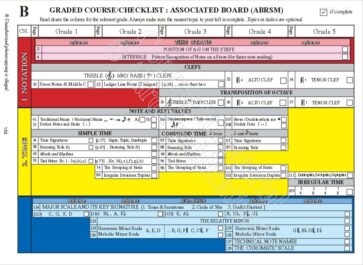
The graded checklists in All-In-One to Grade 5 show the topics required at each grade and make it easy to compare the ABRSM and Trinity College London Music Theory syllabuses.
For closer views of the graded checklists, see the product images on the All-In-One to Grade 5 Music Theory product page.
ABRSM Music Theory graded checklist showing syllabus requirements for each grade.
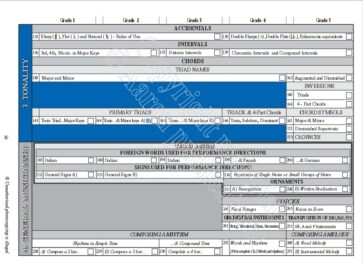
Trinity College London Music Theory graded checklist showing syllabus requirements for each grade.
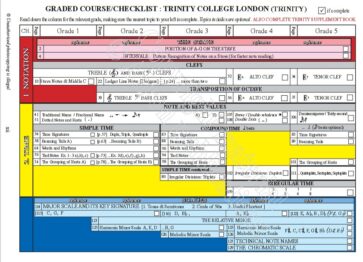

The checklists show at a glance which topics are required at each grade. They make it easy for students to see where the ABRSM and Trinity Music Theory syllabuses overlap and where they differ.
What Are the Differences Between ABRSM and Trinity Music Theory?
Although there are many similarities between the two examination boards, there are also several important differences. These can be seen by comparing the graded syllabus checklists included in the All-In-One Music Theory books.
ABRSM Music Theory follows a more traditional approach and introduces a wider range of key signatures at an earlier stage.
Trinity College London Music Theory places greater emphasis on composition and includes some topics that are particularly useful for students with an interest in jazz and popular music. In addition to Roman numeral analysis, Trinity also introduces jazz chord symbols.
There are also differences in when particular topics are introduced:
- Compound time signatures are introduced at Grade 3 by both examination boards.
- ABRSM students are expected to learn a broader range of key signatures at an earlier stage than Trinity students.
- Trinity students are introduced to major, minor and perfect intervals at Grade 2, one grade earlier than ABRSM students, who encounter them at Grade 3.
These differences mean that, although the two syllabuses cover many of the same fundamental areas of music theory, they do not always introduce topics in the same order or place the same emphasis on them.
For a more detailed comparison, see the graded syllabus checklists provided at the front of the All-In-One Music Theory books.
The Trinity College London Supplement Booklet – All-In-One to Grade 5 contains extension exercises that build upon topics covered in the main workbook, as well as additional topics and exercises designed to support students following the Trinity syllabus.
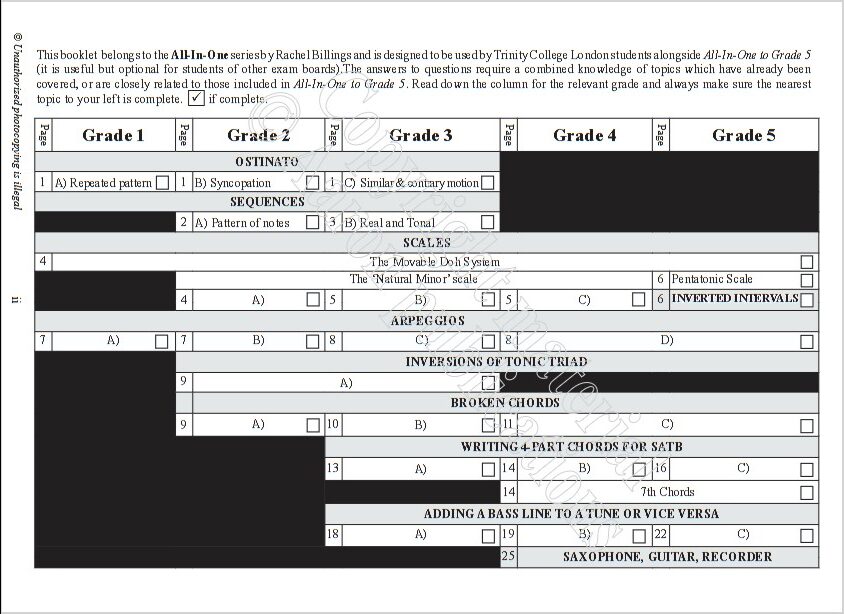
Topics Covered in the Trinity Supplement but Not Explicitly Required by the ABRSM Syllabus
The following topics are covered in the Trinity College London Supplement but are not explicitly included as requirements in the ABRSM Grades 1–5 syllabus:
- Ostinato
- Syncopation
- Real and tonal sequences
- The natural minor scale
- The pentatonic scale
- Inverted intervals
- Arpeggios
- Inversion of tonic triads
- Broken chords
- Writing four-part chords for SATB
- Dominant 7th chords
- Basic knowledge of the guitar and saxophone
Detailed information about syllabus requirements can be found on other pages of this website, next to relavent articles. For example:
Part 1: Aural Exercises: Real and Tonal Sequences (Grades 4 – 5 Aural Exercises)
F.A.Q section at the bottom of the page answers the question: Do both ABRSM and Trinity students need to know about sequences?
Trinity College London Music Theory Grades 1–5
Trinity College London offers Music Theory examinations from Grades 1–5. Although Trinity and ABRSM cover many of the same areas, Trinity includes additional topics that students following the All-In-One to Grade 5 (Third Edition) need to study separately.
The Trinity College London Music Theory Supplement covers these additional topics in a 26-page workbook and is designed to be used alongside All-In-One to Grade 5.
Which Music Theory book do I need for Trinity or ABRSM?
The All-In-One Music Theory series has been written to support students preparing for both ABRSM and Trinity College London examinations.
- ABRSM students require only one book: All-In-One to Grade 5, All-In-One: Grades 1–3 or All-In-One: Grades 4–5.
- Trinity College London students using All-In-One to Grade 5 (Third Edition) should also use the Trinity College London Music Theory Supplement alongside the main book.
- Trinity students using All-In-One: Grades 1–3 or All-In-One: Grades 4–5 do not need the separate Trinity Supplement because the relevant additional Trinity material is already included in the appendices.
The Trinity Supplement introduces topics that build naturally on material already covered in the main book. For example, students who understand tonic chords and inversions will find broken chords a straightforward next step. Similarly, students who understand diatonic intervals can build on this knowledge when learning about inverted intervals.
Many students, not only those taking Trinity examinations, find this additional music theory material valuable.
Which is better: ABRSM or Trinity Music Theory?
Neither examination board is simply better than the other. Both provide a structured approach to music theory, but they differ in the topics they introduce and the way some areas are assessed.
If you are choosing between ABRSM and Trinity College London Music Theory, look at the syllabus for your particular grade and consider which approach best suits your needs.
Relevant articles:
Is Grade 6 Music theory much harder than Grade 5?
View our article: Can I Use My Trinity Grade 5 Theory Pass for ABRSM Grade 6?
Ready to choose your book?
Whether you’re studying for ABRSM or Trinity College London, the All-In-One Music Theory series provides a structured way to prepare for your exams. Explore the All-In-One Music Theory workbooks and Revision booklets including the All-In-One to Grade 5, Grades 1–3 and Grades 4–5 editions.
Studying Trinity using All-In-One to Grade 5 (Third Edition)?
You will also need the Trinity College London Music Theory Supplement.

Hi Andro,
I am pleased to answer your query. In 2004 Trinity College London’s performing arts examinations merged with Guildhall School of Music and Drama to form the ‘Trinity Guildhall’ examinations board. The name Trinity Guildhall was dropped on 31st July 2012, and the board’s performing arts examinations are now offered under the Trinity College London brand.
i.e. Trinity Guildhall and Trinity College London are one and the same.
Regards, Rachel