Chord Inversions Explained: Root Position, First and Second Inversion
A chord inversion occurs when a chord is arranged so that a note other than its root is in the bass. For a triad, there are three possible positions: root position, first inversion and second inversion.
Understanding chord inversions is an important part of learning harmony and is particularly useful for students studying music theory and preparing for graded examinations.
Many students can recognise chords in root position, but inversions can initially seem confusing because the notes are rearranged and the bass note changes.
The All-In-One Music Theory books introduce chord inversions step-by-step through a highly visual approach, using illustrations, diagrams and carefully designed layouts with minimal text. This makes the presentation concise while still covering the subject in depth, from simple triads through to four-part chords and figured-bass notation.
The article below explains these concepts in a detailed, word-based format. They provide useful explanations online, but the full benefits of the All-In-One visual teaching method can only be experienced through the books themselves.
What Is a Chord Inversion?
A chord inversion occurs when the notes of a chord are rearranged so that a note other than the root becomes the lowest note.
For example, a C major triad contains:
C – E – G
When C is the lowest note, the chord is in root position.
When E becomes the lowest note:
E – G – C
the chord is in first inversion.
When G becomes the lowest note:
G – C – E
the chord is in second inversion.
The most important rule to remember
The inversion of a chord is determined by the bottom note.
It does not matter which note is at the top, or in what order the other notes appear above the bass. To identify the inversion, look at the lowest note.
The Three Types of Triad Inversions
Image: Chord Inversions Triads
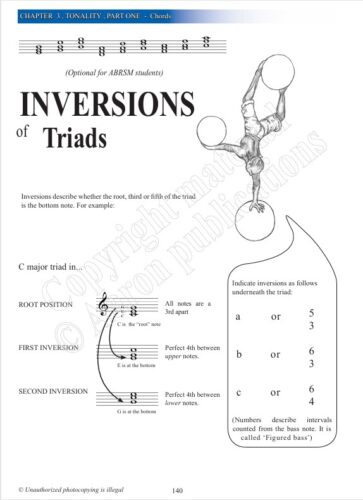
Root Position (5/3)
In root position, the root of the chord is the lowest note.
Example: C major
Bass note: C
Notes: C, E, G
Figured bass:
5/3 — usually not written because it is understood.
First Inversion (6 or 6/3)
In first inversion, the third of the chord is the lowest note.
Example: C major
Bass note: E
Notes: E, G, C
Figured bass:
6/3, usually shortened to 6.
Second Inversion (6/4)
In second inversion, the fifth of the chord is the lowest note.
Example: C major
Bass note: G
Notes: G, C, E
Figured bass:
6/4
How to Identify a Chord Inversion
When identifying a triad inversion, use this simple method:
- Identify the notes in the chord.
- Work out the root of the chord.
- Look at the lowest note.
- Decide whether the bass note is the root, third or fifth.
- This tells you whether the chord is in root position, first inversion or second inversion.
For four-part chords, there may be a repeated note, so it is helpful to identify the three different notes of the chord first.
Why Are Chord Inversions Used?
Composers use chord inversions because they can create smoother and more interesting musical progressions.
Without inversions, chord changes can create large jumps between notes. Inversions allow individual voices, particularly the bass line, to move more naturally.
For example:
C → G → C
can become:
C → G/B → C
The bass line moves more smoothly, creating a stronger sense of musical flow.
This is one reason why understanding chord inversions is important when studying harmony. The same chord can have a different bass note and produce a different effect within a progression.
Understanding Four-Part Chord Inversions
Image: Inversions of Four-Part Chords
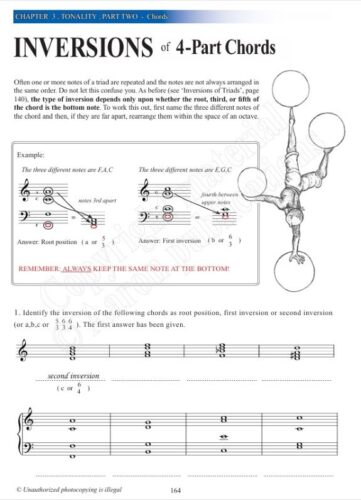
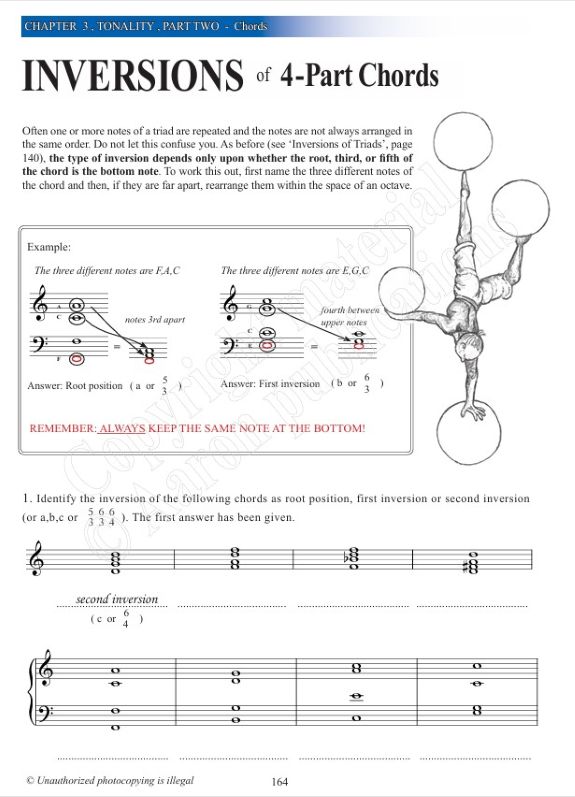
Inversions of Four-Part Chords: Found in All-In-One to Grade 5 and All-In-One: Grades 4–5 workbook
Four-part chords can appear more complicated because one or more notes of the triad may be repeated.
A four-part chord usually contains:
Although the notes may be spread across two staves and arranged differently, the method for identifying the inversion remains the same.
Look at the bass note.
The bass note determines whether the chord is in root position, first inversion or second inversion.
How to Identify a Four-Part Chord Inversion
- Find the three different notes that make up the chord.
- Ignore any repeated notes.
- Look at the lowest note.
- Decide whether the bass note is the root, third or fifth.
- Identify the inversion.
Example
E – G – C – E
The three different notes are:
C, E and G
Because E is the lowest note, this is:
C major, first inversion.
The repeated E does not change the inversion.
Figured Bass and Chord Inversions
Figured bass is a system that shows the intervals above the bass note.
Understanding the relationship between figured bass and chord inversions can help students see why the figures change when the bass note changes.
The common symbols for triads are:
Root position:
5/3
First inversion:
6/3 or 6
Second inversion:
6/4
The numbers do not tell you the name of the chord. They show the intervals between the bass note and the notes above it.
This is why figured bass and chord inversions are closely connected.
Chord Inversions in the VCM Music Theory Syllabus
Chord inversions are included in the new Victoria College of Music (VCM) Music Theory syllabus. From Grade 3, students are tested on chord inversions, with the topic introduced simply and progressively as they develop their understanding of harmony.
This makes chord inversions an important area of study for VCM Music Theory students, as well as for those following other graded music theory syllabuses. Although figured bass becomes particularly relevant at Grade 6, introducing these patterns earlier can provide useful preparation and help students develop a stronger understanding of harmony.
You can see the full VCM Music Theory syllabus requirements, including how chord inversions are introduced at different grades.
Common Mistakes Students Make With Chord Inversions
Looking at the Wrong Note
The lowest note determines the inversion, not the highest note.
Forgetting Doubled Notes
Four-part chords often contain repeated notes. Always identify the three different notes first.
Thinking the Notes Must Appear in a Particular Order
The notes of a chord can be rearranged. They do not have to appear in a particular order above the bass.
The important point is the bass note.
Confusing the Chord Name with the Inversion
The chord name tells you which notes belong to the chord. The inversion tells you which chord note is in the bass.
For example, C–E–G, E–G–C and G–C–E are all forms of a C major chord, but they are in different positions.
Chord Inversions: A Simple Way to Remember Them
For a triad, simply look at the bottom note:
- Root position: root in the bass
- First inversion: third in the bass — a fourth between the upper two notes
- Second inversion: fifth in the bass — a fourth between the lower two notes
For a C major triad:
C – E – G → Root position
E – G – C → First inversion
G – C – E → Second inversion
The notes of the chord have not changed — only the bass note has changed.
Once you understand this simple principle, chord inversions become much easier to recognise. You can begin to see more clearly how chords move, how bass lines are constructed and how harmony works within a piece of music.
Whether you are preparing for a music theory examination, developing your harmony skills, or simply wanting to understand how chords work, recognising chord inversions is an important step towards becoming a more confident musician.
Ready to Practise Chord Inversions?
👉 The clearest explanation of chord inversions, combined with plenty of practice exercises, is found in Chapter 3 of:
These books explain chord inversions step by step and provide plenty of opportunities to practise identifying and writing them.
Aural and General musicianship
For a practical musical example of chord inversions, see:
👉 Shostakovich Piano Tutorial: Waltz No. 2 – Chord Inversions and Hemiolas
This video demonstrates chord inversions in the context of an actual piece of music.
Moving from Grade 5 to Grade 6 Music Theory
If you are moving on from Grade 5 and beginning to study more advanced harmony, you may also find our guide Bridging the Dreaded Gap: How to Transition from Grade 5 to Grade 6 Music Theory Smoothly useful.