
Chopin’s Scherzo No. 2: From Simple Sequences to a Triumphant Musical Arrival
Music theory concepts explored in this performance:
✓ Sequence
✓ Root notes
✓ Real and tonal sequence principles
✓ Modulation
✓ Diminished chords
✓ Enharmonic equivalents
✓ Dominant 7th Chords
✓ Perfect cadence
Simple Concepts – Grand Design
In my beginner article about real and tonal sequences, I explain the difference between them and show how a sequence is a musical pattern which is repeated while being moved to a new pitch level.
In this performance example from Chopin’s Scherzo No. 2, beginning at bar 460, we can hear this same fundamental idea developed on a much larger scale.
What begins as a recognisable sequential pattern gradually becomes a dramatic harmonic journey, incorporating modulation, enharmonic equivalents, colourful diminished harmony and culminating in a powerful and triumphant perfect cadence in B-flat minor.
Audio Clip: Full passage — bars 460–544+
Bars 476–491: Preparing the Journey
 Bars 476 to 491 from Chopin’s Scherzo No.2
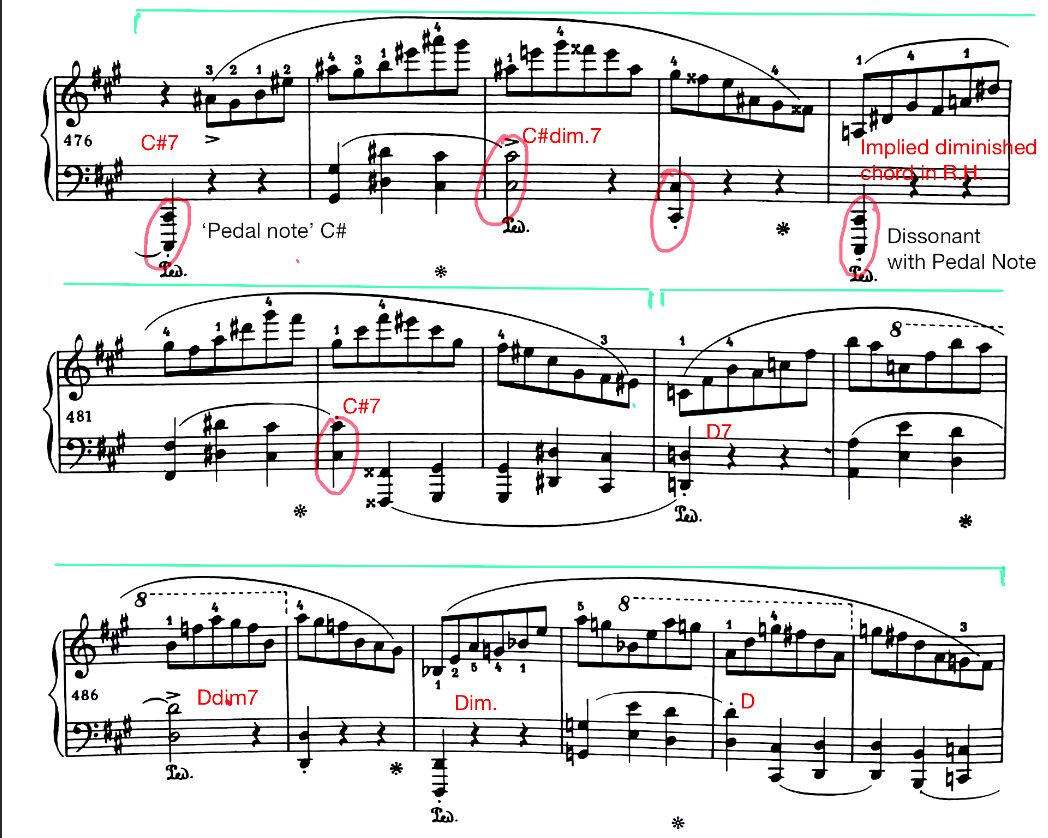
This transitory section begins with an eight-bar phrase.
In the right hand, the pattern begins with a C♯ major chord, moves through increasingly unstable harmonic material, and eventually returns to C♯ major. Beneath this, the left hand repeatedly emphasises C♯ in the bass. The term dissonant harmony below refers to the jarring vertical dissonances created between the repeated bass note in the left hand and the implied harmony in the right hand (for example, between C♯ and D♯ in bars 480–481, and between D and E in bars 488–489).
Right hand: C♯ major chord (bb. 476–477) → diminished harmony (bb. 478–479) → dissonant/clashing harmony (bb. 480–481) → return to C♯ major (bb. 482–483)
Left hand: repeated C♯ in the bass
The pattern then forms a real sequence when it is repeated a tone higher, with all of the intervals between the corresponding notes remaining exactly the same.
Right hand: D major chord (bb. 484–485) → diminished harmony (bb. 486–487) → dissonant/clashing harmony (bb. 488–489) → return to D major (bb. 490–491)
Left hand: repeated D in the bass
The repetition of the root notes in the bass creates a degree of stability. At the same time, however, the music becomes increasingly tense as the pattern moves upwards.
Although there is harmonic movement, there is still a feeling of instability. No key has yet been firmly established and there is no cadence to provide a sense of arrival. The result is unease and expectation.
A sequence occurs when a musical pattern is repeated while being moved to a new pitch level.
This simple principle becomes a powerful compositional technique, helping Chopin create momentum and prepare the listener for what follows.
Bars 492–515: Modulation and Pivot Chords
Chopin now introduces another recognisable pattern. In its simplest form, this can be understood as a harmonic and melodic sequence.
Although Chopin varies the motif, breaks it into smaller fragments and places parts of it in different octaves, the underlying idea remains recognisable.
The pattern first occurs in G minor , bars 492–499, before changing key through a process called modulation.

[I have quoted it down an octave for the purpose of simplification]
When the pattern reoccurs in bars 500 to 507 it is in C minor, it is a real sequence, a perfect 4th higher.

How does Chopin move from one key to another?
Remarkably, the change begins with just one note.
Chopin raises the third of the G minor chord by a semitone, changing B♭ to B natural. This transforms G minor into G major, which can function as the dominant of the new key, C minor.
The dominant-to-tonic relationship is one of the strongest in tonal music. When the dominant moves to the tonic, it creates a strong sense of arrival and helps establish the new key. The addition of the seventh to the dominant chord further strengthens its pull towards the tonic (Explore our free guide to the Dominant 7th and Tonic Progression )
It is also very common for music to move between keys which are a fifth or fourth apart:
G → C → F → B♭
The circle of fifths helps us understand why these relationships are so common and why such key changes can sound natural and convincing.

An Unexpected Change of Direction
At this point, our ears may expect Chopin to continue the predictable pattern:
G minor → C minor → F minor?
But instead, Chopin surprises us.
Rather than continuing to a closely related key, he moves towards A-flat minor, creating a more unexpected change of direction.
The C minor harmony acts as a pivot, helping the music turn towards the new harmonic area.
By changing just one note, Chopin can reinterpret the harmony and redirect the music. The resulting E-flat major chord becomes the dominant of A-flat minor.
The movement of the root notes also helps establish the new destination:
C → E♭ → A♭
These notes outline the new tonic area and reinforce the listener’s sense that the music has travelled somewhere new.
Around Bar 516: Why Enharmonic Equivalents Matter
Around bar 516, Chopin introduces an F-flat major chord.
At first this may seem surprising because F-flat is the enharmonic equivalent of E natural. In other words, the two notes sound the same on a modern piano.
So why not simply write E natural?
This is where enharmonic equivalents become much more than a definition students have to memorise.
Why Doesn’t Chopin Simply Write E Major?
The spelling of notes can help us understand their musical function and the direction of the music.
In the preceding passage, the bass has been moving by step through notes associated with A-flat minor:
G → A♭ → B♭ → C♭
The next logical letter name is therefore C♭, rather than B natural.
Writing C♭ preserves the visual and musical pattern of the bass line.
Chopin then uses this harmonic spelling to create a striking change of direction. The enharmonic relationship allows him to move smoothly between two different harmonic interpretations while the listener hears the same pitch.
This is a perfect example of why music theory matters.
A concept which may first appear as a definition in a theory book becomes a tool for understanding why a composer chooses a particular note or chord.
Bars 516–542: Harmonic Colour and Growing Tension
The music soon becomes more firmly established in E major.
Once again, Chopin makes use of the familiar relationship between tonic and dominant harmony, but now he enriches the harmony with increasingly colourful notes.
The dominant chord becomes more complex, creating a richer and more unstable sound.
For more advanced readers, this harmony can be understood as an extended dominant chord containing additional notes above the basic chord.
However, the important thing for the listener is the effect.
The harmony becomes increasingly colourful, tense and unstable.
Diminished Chords: Unease and Drama
Chopin then develops this unstable harmony through a rising sequential movement.
Diminished chords are particularly effective at creating tension because they sound unstable and seem to demand movement towards another harmony.
As the pattern rises, the sense of expectation becomes stronger.
The sequence itself creates momentum, while the diminished harmony adds unease and drama.
Each repetition seems to ask the same question:
When is this tension finally going to end?
Eventually, the unstable harmony is transformed into the dominant of B-flat minor.
The listener is now being drawn unmistakably towards the final destination.
Bars 543–544: The Triumphant Arrival
The Perfect Cadence: Arriving Home
After the harmonic exploration, unexpected changes of key and growing tension, Chopin brings the passage to a powerful conclusion.
The final dominant chord resolves to the tonic of B-flat minor, creating a perfect cadence.
The effect is one of arrival and release.
The listener has travelled through changing harmonic landscapes, colourful chords and increasing instability. Finally, the cadence confirms the destination with clarity and strength.
The journey may sound complex, but its foundations are remarkably simple.
Connecting Back to Music Theory
This passage contains ideas which students begin learning at an early stage:
- sequences
- intervals
- tonic and dominant chords
- keys
- modulation
- enharmonic equivalents
- diminished chords
- cadences
The difference is not in the basic ingredients.
It is in the way a master composer combines them.
A sequence creates movement.
Modulation takes us away from familiar ground.
Enharmonic spelling can help explain musical direction.
Diminished harmony creates instability.
A perfect cadence provides resolution.
Advanced music is made from simple ideas.
Learn More
The All-In-One Music Theory books introduce these essential building blocks in a clear and progressive way.
Students learn individual concepts such as sequences, intervals, chords, keys and cadences. As their understanding develops, they can begin to recognise how composers combine these simple ideas to create increasingly complex and powerful music.
Simple ideas. Powerful music.
The more we understand the building blocks of music, the more we can recognise them in the music we play, hear and love.
Additional Free Music Theory Resources
🎧 Free Aural Exercises Based on Chopin’s Scherzo No. 2
Can you hear the sequences and harmonic changes?
Would you like to explore some of the musical ideas discussed in the accompanying article through listening?
Rachel has created free aural exercises based on passages from Chopin’s Scherzo No. 2, with accompanying worksheets and answers, giving you the opportunity to test your ears and see whether you can hear the sequences and harmonic changes for yourself.
👉 Try the free Chopin Scherzo No. 2 aural exercises →
📚 Related Music Theory articles:
Dominant 7th Chords and Tonic Resolution
Discover why adding the seventh to a dominant chord creates an even stronger pull towards the tonic.
Real and Tonal Sequences
Learn the difference between real and tonal sequences and discover how composers use repeated patterns to create movement and direction.