How to Identify Major Key Signatures (Without Memorising Every Key)


Two of fifteen Reference pages found in Chapter Three of All-In-One to Grade 5, All-In-One: Grades 1-3 and All-In-One: Grades 4-5 books
Learn how to identify major key signatures quickly and confidently using the simple patterns behind sharps and flats.
This guide is ideal for beginners and music theory students, including those preparing for ABRSM, Trinity College London, and Victoria College Music Theory exams.
However, this article is not a substitute for the All-In-One Music Theory workbooks and Revision booklets. While this online guide explains the subject in words, the books present these concepts through a highly visual approach, using diagrams, carefully designed layouts and minimal text to make music theory concise, clear and easier to understand and remember.
The full benefits of the All-In-One method can only be experienced through the books themselves. They provide a comprehensive, structured approach to music theory through Grade 5, offering far more than can be conveyed in an individual online article.
To experience the complete All-In-One approach, we recommend working from All-In-One to Grade 5 or All-In-One Grades 1–3 and All-In-One Grades 4–5.
Have you ever looked at a key signature and wondered:
“How do I know what key this is?”
Many students believe they need to memorise every major key signature. Fortunately, there’s a much easier way.
By understanding the order of sharps and flats, you can work out any major key quickly and confidently.
The secret is learning one simple pattern.
What Is a Key Signature?
A key signature is the group of sharps (♯) or flats (♭) written at the beginning of a piece of music, immediately after the clef.
It tells us which notes are altered throughout the music.
More importantly, it tells us the key of the piece.
The good news is that key signatures aren’t random—they follow clear, predictable patterns.
The Order of Sharps
Every sharp key signature follows exactly the same order:
F – C – G – D – A – E – B
A useful mnemonic is:
Father Charles Goes Down And Ends Battle
Taking the first letter of each word gives:
F C G D A E B
Each new sharp key simply adds the next sharp in this sequence.
Examples
| Key | Sharps |
|---|---|
| G major | F♯ |
| D major | F♯ C♯ |
| A major | F♯ C♯ G♯ |
One Mnemonic Gives You the Order of Flats Too
Many students learn one mnemonic for sharps and another completely different one for flats.
You don’t need to.
Simply read the same phrase backwards:
Battle Ends And Down Goes Charles Father
This gives:
B – E – A – D – G – C – F
That’s the order in which flats appear.
So one phrase gives you both:
Sharps
F – C – G – D – A – E – B
Flats
B – E – A – D – G – C – F
Learning one pattern is much easier than memorising two separate lists.
How to Find a Major Key from a Sharp Key Signature
Once you know the order of sharps, identifying the key is easy.
Rule
The major key is the note immediately above the last sharp.
Example 1
Key signature: F♯
Last sharp: F♯
One note higher: G
Answer: G major
Example 2
Key signature: F♯ C♯ G♯
Last sharp: G♯
One note higher: A
Answer: A major
Example 3
Key signature: F♯ C♯ G♯ D♯
Last sharp: D♯
One note higher: E
Answer: E major
Remember: You don’t need to memorise every sharp key. Simply identify the last sharp and move up one note.
How to Find a Major Key from a Flat Key Signature
Using the order of flats:
B – E – A – D – G – C – F
the rule is different.
Rule
The major key is named after the second-last flat.
Example 1
Key signature: B♭ E♭
Second-last flat: B♭
Answer: B♭ major
Example 2
Key signature: B♭ E♭ A♭
Second-last flat: E♭
Answer: E♭ major
Example 3
Key signature: B♭ E♭ A♭ D♭
Second-last flat: A♭
Answer: A♭ major
The One Exception
There is one flat key signature that doesn’t follow the “second-last flat” rule.
With one flat (B♭), the key is:
F major
This is the only flat major key you need to remember separately.
Why These Patterns Work
These aren’t simply exam shortcuts.
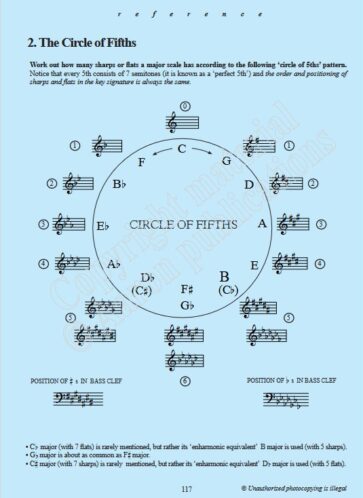
They come directly from the circle of fifths , which shows how every major key is related.
- Moving clockwise adds one sharp at a time.
- Moving anticlockwise adds one flat at a time.
Because the pattern never changes, these rules work every time.
Test Yourself
Can you identify these major keys?
- F♯ C♯
Answer: __________
- B♭ E♭ A♭
Answer: __________
- F♯ C♯ G♯ D♯ A♯
Answer: __________
- B♭ E♭ A♭ D♭
Answer: __________
Ready to practise key signatures?
 This topic is covered in Chapter 3 of All-In-One to Grade 5, All-In-One: Grades 1-3 and All-In-One: Grades 4-5
Common Mistakes
Avoid these common errors:
- Trying to memorise every key signature individually.
- Forgetting that the order of flats is simply the order of sharps in reverse.
- Using the last flat instead of the second-last flat.
- Forgetting the one-flat exception: F major.
- Looking at accidentals in the music instead of the key signature.
Learn the Pattern, Not the List
At All In One Music Theory, the goal isn’t simply to memorise facts.
It’s to understand the patterns that make music theory logical.
Once you know:
- the order of sharps
- the order of flats
- how to identify the tonic
you can work out any major key signature with confidence.
This approach builds genuine understanding and prepares students for:
- ABRSM Music Theory
- Trinity College London Music Theory
- Victoria College Music Theory
Understanding the pattern is far more powerful than memorising isolated facts.
The All-In-One Music Theory workbooks and Revision booklets teach the complete system, covering all topics from beginner to Grade 5, with explanations, examples and exercises.
Related:
How to Build a Major Scale Using Tones and Semitones
Learn how every major scale is constructed using the simple pattern of tones and semitones.