How to Remember Musical Intervals: Easy Patterns, Songs & Ear Training
From recognising visual patterns and interval numbers, to major and perfect intervals, and then to minor and chromatic intervals — with familiar tunes, semitones and ear-training examples.
Learning musical intervals doesn’t have to mean memorising twelve separate facts.
A more useful way to approach intervals is to recognise the patterns and relationships between notes.
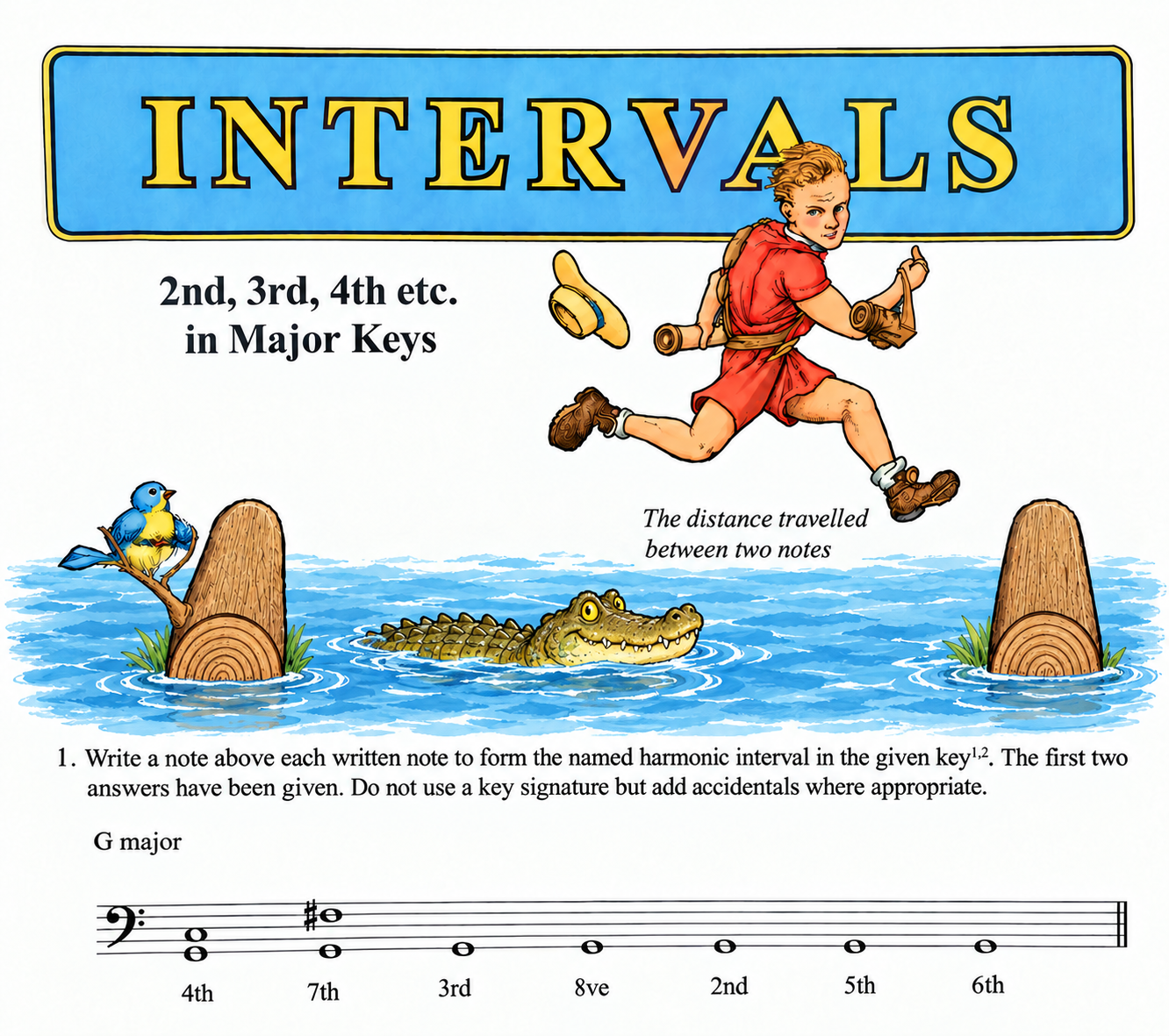
An interval is simply the distance between two notes.
In this article, we’ll work through intervals step by step — from visual patterns and interval numbers, to major, minor and perfect intervals, and finally to chromatic intervals, including augmented and diminished intervals.
Along the way, we’ll use familiar tunes, semitones and ear training to help make the relationships easier to recognise and remember.
Let’s start at the beginning…
But why their names?
It may seem a strange question, but I think it is important to go right back to the beginning and get a basic understanding of how some of our musical relationships developed.
No one person sat down, sang two random notes and thought, “I’m going to name this a major 3rd!”
Music has a fascinating connection with mathematics and nature.
Imagine a string that makes a note when it vibrates. If we divide the string into simple proportions, we find some very important musical intervals.
For example:
1/2 of the string → octave
2/3 of the string → fifth
3/4 of the string → fourth
The Pythagorean tradition explored musical intervals through simple numerical proportions, helping to reveal the mathematical relationships underlying musical harmony.
These simple proportions help explain why the octave, fourth and fifth have such a special place in music theory.
The importance of the fifth can also be heard in the way string instruments are tuned: the open strings of the violin, viola and cello are tuned in fifths.
Why are the 4th and 5th called “Perfect”?
The fourth and fifth come from these simple mathematical relationships. In music theory, they belong to a special group known as Perfect intervals.
So we have:
Perfect octave
Perfect fifth
Perfect fourth
The word “Perfect” isn’t simply another name that has to be memorised. These intervals come from particularly simple mathematical relationships and have a strong, stable sound.
This is why we say Perfect 4th and Perfect 5th, rather than major 4th and major 5th.
For example, if we start with C:
C – F – G – C
F is the 4th and G is the 5th from C. The distance between F and G is a tone.
Now we have the tone we can fill in the remaining spaces:
C – D – E – F – G
The intervals are:
Tone – Tone – Semitone (the left-over bit) – Tone
The first three distances take us from C to F, giving us a Perfect 4th. The final tone takes us from F up to G, making G a Perfect 5th above our starting note, C.
To complete the octave, we continue:
G – A – B – C
giving us another:
Tone – Tone – Semitone
Two matching patterns
We can now see the pattern in the complete octave:
C – D – E – F | G – A – B – C
Tone – Tone – Semitone | Tone | Tone – Tone – Semitone
Each group of four notes is a tetrachord — four notes spanning a Perfect 4th. Both tetrachords have the same Tone – Tone – Semitone pattern, joined by the tone between F and G.
So the major scale can be remembered as:
Tetrachord + Tone + Tetrachord
Recognising this pattern makes the structure of the major scale much easier to remember.
What about the other intervals?
Now let’s look at the complete C major scale:
C – D – E – F – G – A – B – C
The intervals from the starting note C are:
C to D = 2nd
C to E = 3rd
C to F = 4th
C to G = 5th
C to A = 6th
C to B = 7th
C to C = octave
There is a useful pattern here:
2nd, 3rd, 6th and 7th → Major
4th, 5th and octave → Perfect
The 2nd, 3rd, 6th and 7th are called Major intervals when they occur naturally from the tonic of a major scale.
So the names of the intervals are not quite as random as they might first appear.
We can think of them in two groups:
Major: 2nd, 3rd, 6th, 7th
Perfect: 4th, 5th, octave
This gives us a useful pattern to remember before we even start learning what the individual intervals sound like.
From Mathematics to Music
Much later, musicians developed equal temperament, which made the distances between notes more consistent. This made it much easier to play music in different keys while keeping the same basic relationships between the notes.
But the really useful thing for us is not to memorise all of this as a history lesson.
It is to understand that intervals are relationships between notes. Once you start recognising these relationships, remembering intervals becomes much easier.
We’ve seen where some of the names and relationships between intervals come from. Now we can put this understanding into practice by learning to recognise intervals — both by looking at them on the stave and by hearing them.
Pattern Recognition – For Quick Identification of Intervals
You can develop the ability to recognise intervals quickly on the stave by developing strong note-reading skills and learning to recognise patterns.
In the All-In-One Music Theory Books, students learn to recognise the number and visual pattern of an interval before they are expected to memorise clefs and individual note positions. They learn to recognise whether an interval is line-to-line or space-to-space, and how large the gap is between the notes.
The quicker an interval can be recognised from its pattern on the stave, the more readily a student can identify the relationship between notes, whatever the clef.
This is similar to reading a book. Experienced readers do not spell out every letter individually — they recognise familiar patterns and combinations. Musicians develop the same skill when reading notation. As explained in How to Read Music Notes Faster, notes on the stave follow predictable patterns, and the shape of an interval stays the same wherever it appears.
When learning intervals, however, the ear is equally important. Our eyes recognise the pattern while our ears help us hear and anticipate the relationship between the notes. The two skills reinforce each other.
Train Your Ears to Hear and Recognise Intervals
Whilst note-reading skills are important, the most essential part of interval training is listening. Ultimately, our ears guide us towards where the music is going and help us anticipate which note comes next.
One of the most useful ways to begin training your ear is to use familiar tunes as memory anchors.
Use Familiar Tunes as Memory Anchors
By listening to familiar tunes, we can begin to train our ears to recognise different intervals.
Think of a familiar tune as an anchor — something that helps you remember the sound of an interval.
For example, when you hear a major 2nd, you might immediately think of the opening of Happy Birthday.
When you hear a major 3rd, you might think of the opening of When the Saints Go Marching In.
The tune gives your ear something familiar to hold on to.
But the ultimate aim is to move from:
“That sounds like the opening of When the Saints Go Marching In.”
to:
“I immediately recognise that sound as a major 3rd.”
The familiar tune is the stepping stone. With practice, you want to recognise the interval itself, without needing to think of the song.
This is where aural training comes in.
Ascending interval examples
| Interval | Semitones | Ascending example | Familiar tune |
| Major 2nd | 2 | C → D | Happy Birthday |
| Major 3rd | 4 | C → E | When the Saints Go Marching In |
| Perfect 4th | 5 | C → F | Amazing Grace |
| Perfect 5th | 7 | C → G | Twinkle, Twinkle, Little Star |
| Major 6th | 9 | C → A | My Bonnie Lies Over the Ocean |
| Major 7th | 11 | C → B | Interval only (no familiar tune) |
| Octave | 12 | C → C | Somewhere Over the Rainbow |
Descending interval examples
It is useful to learn intervals in both directions. The distance between the notes remains the same, but an interval can sound quite different when it is descending rather than ascending.
| Interval | Semitones | Descending example | Familiar tune |
| Major 2nd | 2 | D → C | Mary Had a Little Lamb |
| Major 3rd | 4 | E → C | Swing Low, Sweet Chariot |
| Perfect 4th | 5 | F → C | O Come, All Ye Faithful |
| Perfect 5th | 7 | G → C | The Flintstones |
| Major 6th | 9 | A → C | Nobody Knows the Trouble I’ve Seen |
| Major 7th | 11 | B → C | I Love You (Cole Porter) |
| Octave | 12 | C → C | Willow Weep for Me |
Hear Musical Intervals in Real Music
Familiar tunes are a useful starting point for learning to recognise intervals, but intervals are not confined to the opening notes of well-known songs.
As you become more confident, try listening for intervals within melodies and musical phrases. Recognising how notes relate to one another in real music helps you move beyond memorising individual examples and towards understanding how intervals work in practice.
To develop your listening skills further, read Hearing Musical Intervals in Real Music.
Six Ways to Recognise an Interval
There are several ways to recognise an interval, and listening to real music is just one of them. Let’s bring together the six useful clues that can help you identify intervals more confidently.
👀 1. Visual pattern
What does the interval look like on the stave?
Pattern recognition is an important part of learning to read music.
🔢 2. Number
How many letter names does it contain?
For example, C to E is a 3rd because C–D–E contains three letter names.
🎹 3. Keyboard pattern
How many semitones separate the notes?
The number of semitones in a particular interval is always the same, whatever note you start from.
🎵 4. Sound
What does the interval actually sound like?
This is where aural training becomes particularly important.
🎤 5. Familiar tune
Does a familiar melody begin with that interval?
A familiar tune can act as an anchor while you are learning.
🔄 6. Musical relationship
Can you recognise the same interval when it starts on a different note?
Using several of these clues together is much more powerful than simply memorising a list.
Learn Intervals as Relationships
This is perhaps the most important idea of all.
If you understand the relationships between intervals, you can often work things out rather than having to memorise every interval separately.
For example:
Minor interval = one semitone smaller than the corresponding major interval.
So if a major 3rd is 4 semitones, a minor 3rd is 3 semitones.
If a major 6th is 9 semitones, a minor 6th is 8 semitones.
This gives us another useful pattern.
For example, C–E, D–F♯ and E–G♯ are all major 3rds. The notes have changed, but the relationship has not: each interval is 4 semitones.
The same idea of recognising relationships rather than isolated notes also appears when we look at real and tonal sequences in music.
The Tritone: Halfway Through the Octave
The chromatic scale divides the octave into 12 semitones.
At the halfway point, we reach 6 semitones.
This is the tritone — an interval of three whole tones.
For example:
C → D → E → F♯
There are three whole tones:
C–D = tone
D–E = tone
E–F♯ = tone
So C to F♯ is a tritone.
The remaining distance from F♯ up to the next C is also 6 semitones:
F♯ → C = 6 semitones
The octave can therefore be divided into two equal tritones:
C → F♯ → C
The tritone can be written in two ways:
C → F♯ = augmented 4th
C → G♭ = diminished 5th
Both are 6 semitones — exactly half an octave. Although F♯ and G♭ sound the same on an equal-tempered instrument, the spelling determines the name of the interval.
Very few pieces of music begin with an augmented 4th. The Simpsons theme is one familiar exception.
As explained on page 159 of All-In-One to Grade 5 (or page 56 of All-In-One Grades 4–5):
“Chromatic intervals are intervals whose upper note is NOT present in major or minor scales when the bottom note is treated as if it is the key note.”
A tritone cannot be major, minor or perfect. Since F♯ and G♭ are not found in the C major or C minor scale, C–F♯ and C–G♭ are chromatic intervals.
There are many exercises for identifying and writing augmented and diminished intervals in the All-In-One Music Theory books, including All-In-One: Grades 4–5. The minor 2nd, augmented 4th and diminished 5th are examples of chromatic intervals. You can also practise these with the Grade 5 Chromatic and Compound Intervals Worksheet.
All Twelve Intervals Within the Octave
The audio examples below bring together all twelve intervals within the octave, including both ascending and descending examples. You can use them as a quick reference when practising interval recognition.
Some of the familiar tunes have already appeared earlier in the article. They are repeated here so that all twelve intervals can be heard together as one complete set.
| Interval | Semitones | Ascending | Descending |
|---|---|---|---|
| Minor 2nd | 1 | Jaws |
Für Elise |
| Major 2nd | 2 | Happy Birthday |
Mary Had a Little Lamb |
| Minor 3rd | 3 | Greensleeves |
Hey Jude |
| Major 3rd | 4 | When the Saints Go Marching In |
Swing Low, Sweet Chariot |
| Perfect 4th | 5 | Amazing Grace |
O Come, All Ye Faithful |
| Tritone | 6 | The Simpsons |
Interval only (no familiar tune) |
| Perfect 5th | 7 | Twinkle, Twinkle, Little Star |
The Flintstones |
| Minor 6th | 8 | The Entertainer |
Love Story theme (Francis Lai) |
| Major 6th | 9 | My Bonnie Lies Over the Ocean |
Nobody Knows the Trouble I’ve Seen |
| Minor 7th | 10 | Somewhere (West Side Story) |
An American in Paris |
| Major 7th | 10 | Interval only (no familiar tune) |
I Love You (Cole Porter) |
| Perfect 8ve | 12 | Somewhere Over the Rainbow |
Willow Weep for Me |
The tritone is highlighted because it sits exactly halfway through the octave.
The important thing to remember is that the number of semitones in a particular named interval is always the same, whatever note you start from.
For example:
C → E = 4 semitones
D → F♯ = 4 semitones
G → B = 4 semitones
They are all major 3rds.
The notes have changed, but the relationship has not.
From Pattern Recognition to Naming Intervals
We’ve seen that intervals can be recognised in several ways: by their visual pattern, number, sound and musical relationship.
These skills can then be developed step by step — from recognising the number of an interval to identifying its quality, and eventually to naming chromatic intervals, including augmented and diminished intervals.
This is the approach used throughout the All-In-One Music Theory books, where intervals are introduced simply and then revisited with increasing depth.
The aim is not to memorise twelve separate sounds, but to become confident at seeing, hearing and understanding the relationships between notes.
Interval Ear Training: From Memory to Understanding
Once you have a few anchor intervals, practise identifying them in different keys.
Start with a small group, perhaps:
- Major 2nd
- Major 3rd
- Perfect 4th
- Perfect 5th
Use the root note as your anchor.
Play the root on your instrument, then sing the interval above it.
Now check the note you have sung by playing it on your instrument.
Did you sing the correct note?
Then:
Try the same interval starting from a different root note.
Try singing it descending.
Gradually introduce the wider intervals and their minor forms.
The aim is not simply to remember that a particular song begins with a particular interval.
The song is there to help you find the sound.
With practice, you can move from recognising an interval because it reminds you of a familiar tune to recognising it immediately as a musical relationship.
That is when interval training becomes much more than another theory fact to memorise.
Ready to test your aural skills?
Try Hearing Musical Intervals in Real Music ⟶